
The short answer
Boat owners have used wax for years.
Wax adds shine, helps protect the surface for a short period, and has been part of traditional boat maintenance for a long time.
Marine ceramic coating is a more advanced option.
It is designed to bond to properly prepared boat surfaces and provide longer-lasting gloss, slickness, easier cleaning, and improved resistance to salt, waterline grime, UV exposure, and environmental buildup.
So which is better?
For short-term shine and lower upfront cost, wax can still make sense.
For longer-term maintenance help, easier cleaning, and better surface behavior, marine ceramic coating is usually the stronger choice.
At Kickin’ Customs in Raynham, MA, we install marine ceramic coatings for boat owners across Massachusetts, Rhode Island, Cape Cod, South Coast, Buzzards Bay, Plymouth, Dartmouth, Fall River, New Bedford, Wareham, and surrounding boating areas.
The key is understanding what ceramic coating does, what wax does, and what neither one should be expected to do.
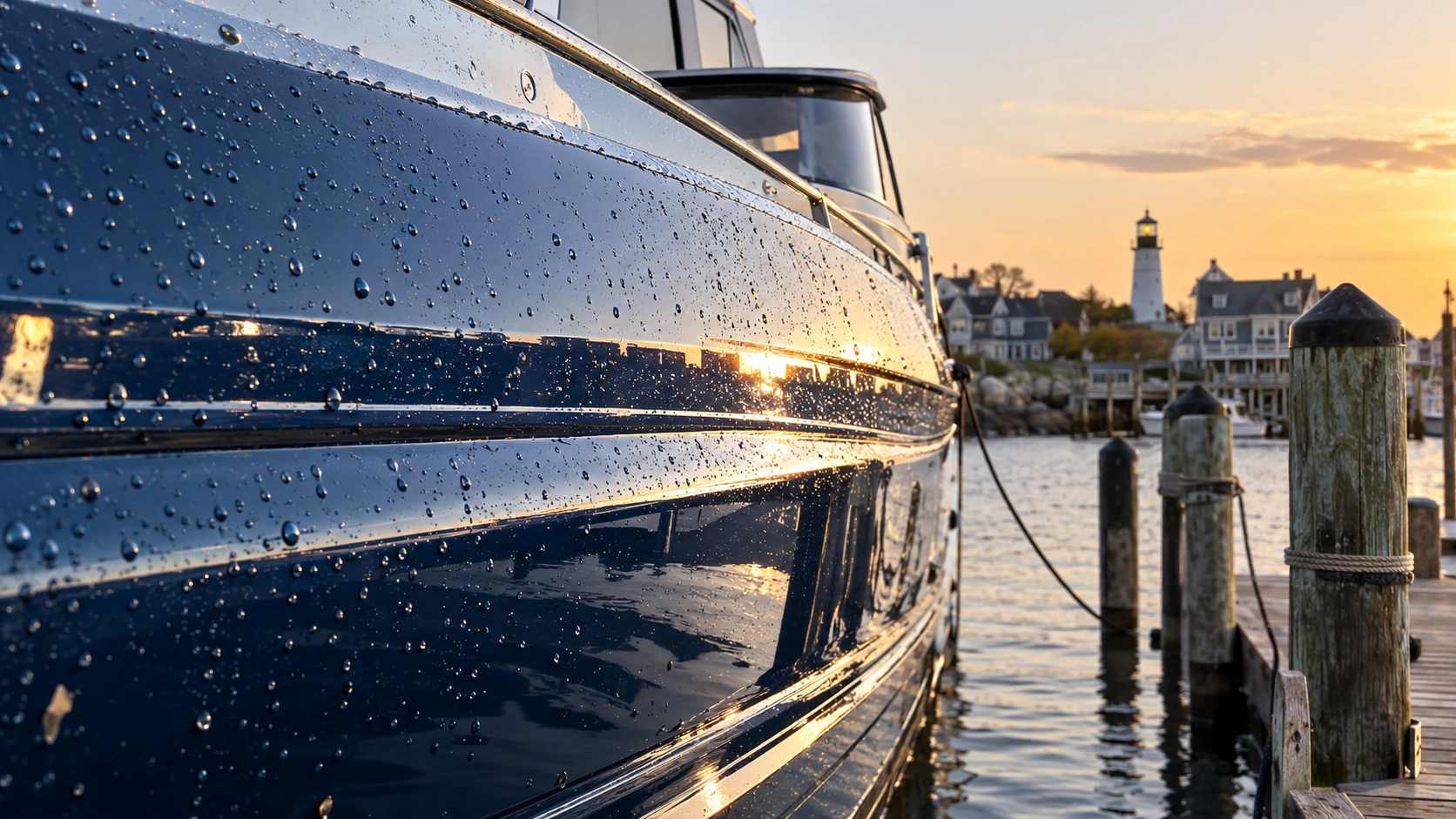
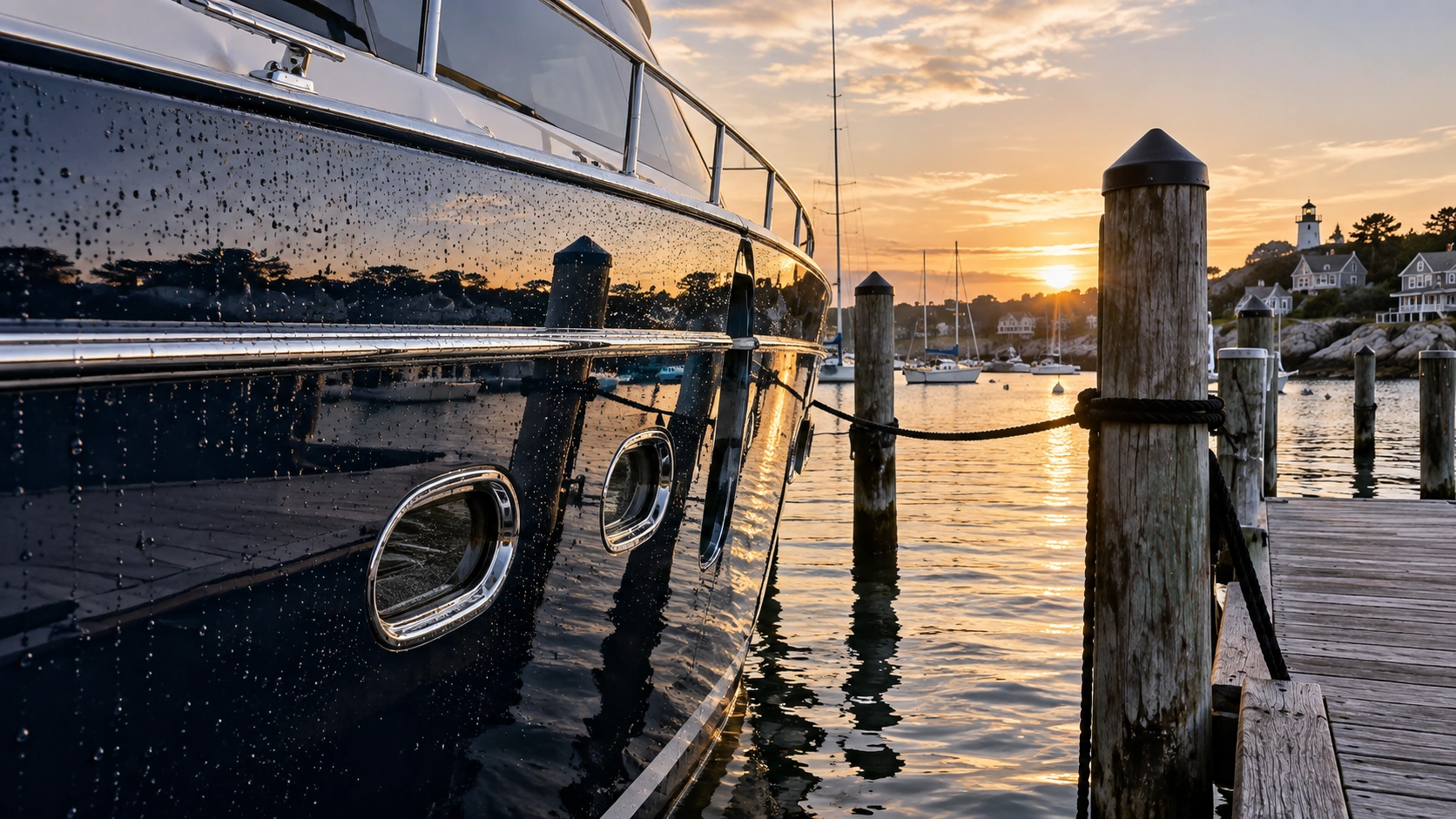
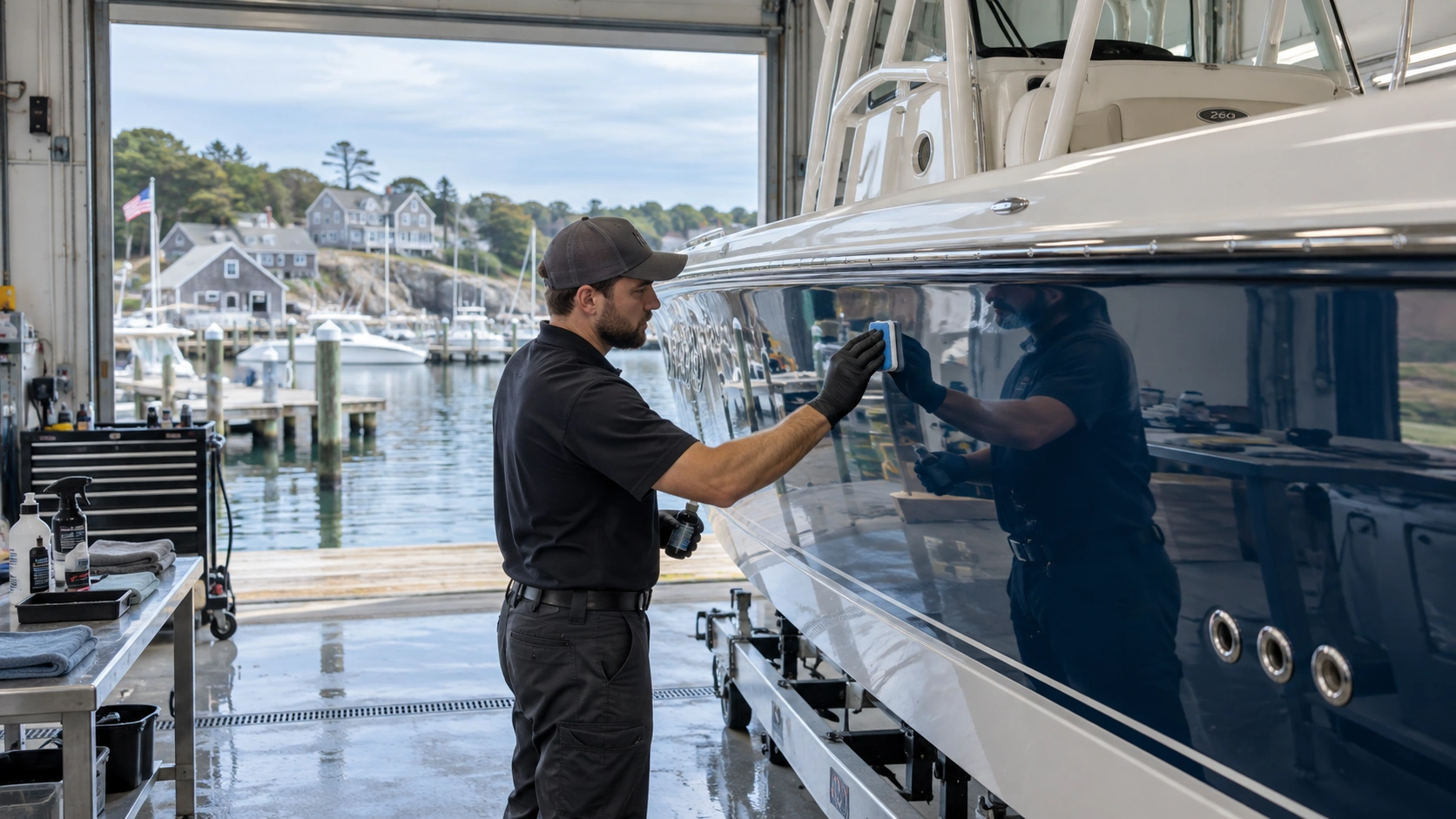
Marine imagery shown in this guide is illustrative.
Wax and ceramic coating
What Is Boat Wax?
Boat wax is a traditional protective product applied to gelcoat, paint, or other suitable surfaces to add gloss and a temporary layer of protection.
Wax can make a boat look better.
It can help water bead for a period of time.
It can make the surface feel smoother.
It can help slow down some surface contamination.
The downside is durability.
Wax wears down from sun, salt, washing, water, heat, cleaners, and normal use. On boats, that wear can happen quickly because marine surfaces take constant abuse.
Wax is useful, but it is not a long-term solution for owners who want easier maintenance throughout the season.
What Is Marine Ceramic Coating?
Marine ceramic coating is a liquid-applied protective coating designed to bond to properly prepared boat surfaces.
Once installed, it creates a slicker, glossier, easier-to-clean surface compared to unprotected or traditionally waxed surfaces.
Marine ceramic coating can help with salt cleanup, waterline grime, UV exposure, staining, oxidation resistance, and general maintenance.
It does not mean the boat never needs washing.
It does not make the boat scratch-proof.
It does not stop every water spot.
It does not replace good maintenance.
But it can make the boat easier to care for and help preserve the surface better than traditional wax when installed and maintained properly.
The Biggest Difference Is Durability
The biggest difference between ceramic coating and wax is durability.
Wax is temporary.
It can look great at first, but it breaks down with sun exposure, saltwater, washing, and regular use.
Marine ceramic coating is designed to last longer than traditional wax when the surface is properly prepared and the coating is maintained correctly.
That longer durability is why many boat owners choose coating.
Instead of re-waxing repeatedly through the season, the owner gets a longer-lasting protective layer that helps with cleaning and gloss over time.
For boats that are used often, that matters.
Ceramic Coating Makes Cleaning Easier
One of the biggest benefits of marine ceramic coating is easier cleaning.
Boats get dirty fast.
Salt dries on the surface.
Waterline grime builds up.
Bird droppings land on the deck.
Sunscreen transfers from hands and skin.
Fish residue, fuel residue, mildew, dock dirt, and environmental fallout all add up.
A ceramic coating creates a slicker surface that can make contaminants harder to bond to the boat.
That can make washing and rinsing easier.
The boat still needs cleaning, but the cleaning process can become less frustrating.
Wax Can Help Cleaning, But Not as Long
Wax can also make a surface feel slick and easier to clean right after application.
The issue is that wax wears down.
Once the wax breaks down, the surface loses slickness and becomes harder to clean again.
On a boat, wax can degrade from UV exposure, salt, washing, and repeated water contact.
This means the benefit may not last as long as owners want.
If the boat is used frequently, docked outside, or exposed to saltwater, wax may need to be reapplied often to keep working well.
Ceramic coating is built for longer-term performance.
Gloss and Appearance
Both wax and ceramic coating can improve gloss.
A freshly waxed boat can look excellent.
A properly coated boat can also look glossy, deep, and clean.
The difference is how long that look is easier to maintain.
Wax can produce a nice short-term shine, but it usually fades as the wax wears down.
Ceramic coating can help preserve gloss longer when the surface is properly prepared and maintained.
The coating does not replace polishing or correction.
If the gelcoat or paint is dull, oxidized, or stained, prep work may be needed before coating.
The final look depends heavily on the surface condition before protection is applied.
Prep Matters More Than People Think
Whether you use wax or ceramic coating, prep matters.
If the boat surface is oxidized, stained, chalky, water-spotted, or contaminated, simply putting wax or coating over it will not fix the problem.
Wax may temporarily improve the appearance.
Ceramic coating may lock in the current condition if prep is skipped.
That is why marine ceramic coating usually requires more prep than a quick wax.
The surface may need washing, decontamination, polishing, oxidation removal, or correction before coating.
The better the prep, the better the result.
Gelcoat and painted surfaces
Ceramic Coating for Gelcoat
Gelcoat is common on boats, and it needs consistent care.
Sun, salt, water, and cleaning can cause gelcoat to oxidize, dull, stain, and lose gloss over time.
Marine ceramic coating can help protect properly prepared gelcoat by adding slickness, gloss, and easier cleaning.
This can help reduce how quickly grime bonds to the surface and make maintenance easier throughout the season.
It does not stop gelcoat from ever aging.
But compared to relying only on wax, coating can provide a stronger long-term maintenance advantage.
Wax on Gelcoat
Wax has been used on gelcoat for decades.
It can improve shine and add a temporary layer of protection.
For owners who enjoy traditional maintenance or want a lower-cost short-term option, wax can still work.
The issue is frequency.
Gelcoat on a boat sees a lot of sun and water exposure. Wax may not hold up long enough for owners who want easier care throughout the season.
If the boat spends a lot of time outside or in saltwater, wax may become a recurring chore.
Ceramic coating is usually better for owners who want longer-lasting help.
Ceramic Coating for Painted Boats
Painted boats can benefit from marine ceramic coating because painted surfaces often show water spots, salt residue, staining, and gloss loss more noticeably.
Dark painted hulls can be especially demanding.
A ceramic coating can help maintain gloss and make cleaning easier.
It can also help reduce how strongly salt, grime, and buildup bond to the surface.
For painted boats, coating can be especially valuable when paired with marine paint protection film in high-contact areas.
Coating helps with maintenance.
PPF helps protect against physical wear.
Wax on Painted Boats
Wax can add gloss to painted boats, but it is still a short-term layer.
On dark painted surfaces, wax may look good at first but break down with sun, salt, washing, and exposure.
Once it breaks down, water spots and grime may become harder to manage.
Wax can still be part of a maintenance routine, but it does not provide the same longer-term performance as a quality ceramic coating.
For high-value painted boats, ceramic coating is often the better choice.
Salt, sun and surface exposure
Salt Exposure
Salt is one of the biggest reasons marine ceramic coating makes sense.
Saltwater dries on the boat and leaves residue.
If it is not cleaned properly, it can contribute to staining, buildup, and surface wear.
A ceramic coating helps make the surface slicker, which can make salt easier to rinse and wash away.
That does not mean salt can be ignored.
Saltwater boats still need regular rinsing and cleaning.
The coating simply helps make that process easier and helps protect the surface during normal use.
Wax and Salt Exposure
Wax can provide some short-term help against salt exposure, but saltwater is tough on wax.
Repeated exposure, washing, and sun can wear wax down quickly.
Once the wax layer breaks down, salt and grime can bond more directly to the surface.
This is why many saltwater boat owners look for longer-lasting protection.
Wax may be fine for occasional use, but for boats that spend real time in saltwater, ceramic coating is usually the better maintenance tool.
Waterline Grime
Waterline grime is one of the most annoying parts of boat ownership.
Scum, stains, minerals, salt, algae, and organic buildup can create a dirty line that takes effort to clean.
Marine ceramic coating can help reduce how strongly grime bonds to coated surfaces.
This may make cleaning the waterline easier when maintained properly.
It does not mean the waterline never gets dirty.
It does not mean you can leave grime sitting for weeks without consequences.
But it can make routine cleaning more manageable.
For many boat owners, that is one of the biggest benefits.
Wax and Waterline Grime
Wax can help for a short time, but waterline grime can break down or overwhelm wax quickly.
The waterline is one of the harshest areas on the boat.
It is constantly exposed to water, contaminants, sun, and cleaning.
Wax may lose effectiveness faster there than on upper surfaces.
If the boat sits in the water or is used frequently, wax may not offer enough long-term help.
Ceramic coating is usually better suited for owners who want easier waterline maintenance.
UV Exposure
Boats take heavy UV exposure.
The sun hits the boat directly.
Water reflects sunlight back upward.
Bright decks and surrounding surfaces increase glare and heat.
UV exposure contributes to oxidation, fading, drying, and surface aging.
Marine ceramic coating can help add UV resistance to properly prepared surfaces.
It is not a replacement for covered storage, proper washing, or regular care.
But it can help slow surface degradation compared to leaving the boat unprotected or relying only on short-term wax.
For boats stored outside, UV protection is a major reason to consider coating.
Wax and UV Exposure
Wax can help with UV exposure for a limited time.
The problem is that UV rays are one of the things that break wax down.
As the wax degrades, the surface loses protection.
That means the owner has to reapply wax regularly to keep the benefit.
For boats stored outdoors or used heavily during summer, this can become repetitive.
Ceramic coating is designed to offer a longer-lasting protective layer.
For owners who want less frequent maintenance, coating is usually the better choice.
Oxidation Resistance
Gelcoat oxidation is a common issue.
Over time, the surface can become dull, chalky, faded, or harder to clean.
Marine ceramic coating can help slow oxidation on properly prepared surfaces by adding a protective layer against UV, water, and environmental exposure.
It does not fix oxidation by itself.
If the surface is already oxidized, it usually needs polishing or correction first.
Wax can also add temporary protection, but it breaks down faster.
For long-term oxidation resistance, ceramic coating is usually stronger.
Water Spotting
Water spots are another common boat maintenance issue.
Minerals in water can dry on the surface and leave marks.
Ceramic coating can make the surface slicker and easier to clean, but it does not make water spots impossible.
If water is allowed to dry on the surface, spotting can still happen.
This is especially true in direct sun, with hard water, or after saltwater use.
The benefit of coating is that spots may be easier to clean if handled properly.
Owners still need to rinse, wash, and dry the boat correctly.
Wax and Water Spots
Wax can help water bead, but it does not stop water spots either.
As wax wears down, spotting can become harder to manage.
Waxed surfaces may still need careful drying and maintenance.
If the boat is washed often or exposed to hard water, the wax layer may not last long.
Ceramic coating offers better long-term slickness and easier cleanup, but it still requires good washing habits.
Neither wax nor coating eliminates the need to dry and maintain the boat.
Stain Resistance
Marine ceramic coating can help improve resistance to certain stains by making the surface less porous and easier to clean.
This can help with bird droppings, salt residue, grime, fish residue, fuel residue, and other contaminants when cleaned promptly.
It does not make the boat stain-proof.
If contaminants sit too long, especially in heat and sun, they can still cause problems.
The value of coating is that cleaning is usually easier and the surface has more protection than bare gelcoat, paint, or wax alone.
Wax and Staining
Wax can provide some short-term stain resistance, but it is limited.
Wax can soften, wear away, or break down from heat, sun, cleaners, and water exposure.
Once the wax is compromised, the underlying surface becomes more vulnerable.
For boat owners who deal with frequent grime, bird droppings, fish mess, or marina dirt, ceramic coating is usually a stronger maintenance option.
Wax may still help, but it requires more frequent upkeep.
Slickness
Slickness is one of the reasons ceramic coating feels different from wax.
A coated surface often feels smoother and less grabby.
That slickness helps dirt, salt, and grime release more easily during washing.
Wax can also feel slick at first, but that feel usually fades as the wax wears down.
On a boat, slickness matters because cleaning is constant.
A surface that releases grime faster saves effort over time.
This is one of the biggest practical differences between ceramic coating and wax.
Care, durability and cost
Maintenance Expectations
Marine ceramic coating reduces maintenance effort, but it does not eliminate maintenance.
The boat still needs to be rinsed after use.
Salt should still be removed.
Waterline grime should still be cleaned regularly.
Bird droppings and contaminants should still be handled quickly.
The surface should still be washed with appropriate products.
Maintenance boosters may be recommended depending on the coating system.
The coating makes care easier, not optional.
Boat owners who understand this get the best results.
Wax Maintenance Expectations
Wax requires more frequent maintenance.
Depending on use, exposure, washing, and storage, wax may need to be reapplied multiple times during the season.
Some owners enjoy this routine.
Others get tired of it.
For boats that are used occasionally and stored well, wax may be acceptable.
For boats that are used often, sit outside, or spend time in saltwater, wax can become a constant project.
Ceramic coating is often chosen because owners want longer-lasting help.
Durability Expectations
Marine ceramic coating is more durable than wax, but durability still depends on real conditions.
Boat use matters.
Saltwater exposure matters.
Storage matters.
Washing habits matter.
Sun exposure matters.
Surface prep matters.
Product choice matters.
A coated boat that is rinsed, washed, and maintained properly will usually perform better than one that is neglected.
A ceramic coating should not be sold as maintenance-free or permanent.
It is a durable protection system that still needs care.
Wax Durability Expectations
Wax durability is much shorter.
It may look good after application, but the protection fades as the boat is used.
Sun, salt, washing, friction, cleaners, and water exposure all reduce wax life.
If the boat is docked outside or used often, wax durability can be disappointing.
That does not make wax useless.
It just means it is a shorter-term product.
For owners who want longer-term maintenance help, ceramic coating is usually the better investment.
Cost Difference
Wax usually costs less upfront.
Ceramic coating usually costs more because it requires more prep, more technical application, and longer-lasting product performance.
That higher upfront cost can make sense if it saves cleaning time, reduces repeated waxing, preserves gloss, and makes the boat easier to maintain.
The right choice depends on how the boat is used and how much the owner values time, appearance, and maintenance ease.
For some owners, wax is enough.
For others, ceramic coating is the smarter long-term option.
Time Difference
Waxing a boat takes time, and repeated waxing takes even more time.
Boat owners already spend plenty of time cleaning, rinsing, drying, covering, uncovering, fueling, loading, unloading, and maintaining the boat.
Ceramic coating can reduce the need for frequent waxing and make regular cleaning easier.
For busy owners, this time savings can be one of the biggest reasons to choose coating.
It is not only about shine.
It is about reducing the workload of ownership.
Match your boat and its use
Best Option for New Boats
New boats are strong candidates for marine ceramic coating.
The surfaces are usually in better condition, which can make prep more straightforward.
Adding coating early can help preserve gloss and make cleaning easier from the beginning.
New boats start getting exposed to sun, salt, waterline grime, and cleaning immediately.
Ceramic coating helps protect the boat before oxidation and staining become bigger issues.
Wax can be used on a new boat, but coating usually offers a stronger long-term plan.
Best Option for Used Boats
Used boats can benefit from ceramic coating too, but prep is more important.
A used boat may have oxidation, staining, water spots, old wax, scratches, or faded gelcoat.
Those issues need to be addressed before coating whenever possible.
A ceramic coating will not automatically fix a worn surface.
It protects the condition underneath.
For used boats, the best process may include washing, decontamination, polishing, oxidation removal, and then coating.
Wax may be a cheaper short-term improvement, but coating is better after proper prep.
Best Option for Oxidized Boats
If the boat is oxidized, neither wax nor ceramic coating should be viewed as a shortcut.
Oxidation needs to be corrected first.
Wax can temporarily make oxidized gelcoat look better, but the improvement may not last.
Ceramic coating should be applied after the surface is properly prepared.
Coating over oxidation can lock in a poor finish and reduce the quality of the result.
For oxidized boats, restoration comes first.
Protection comes after.
Best Option for Dark Hulls
Dark hulls are demanding.
They show water spots, salt, oxidation, scratches, and staining more easily than lighter finishes.
Ceramic coating can be especially helpful on dark hulls because it adds slickness, gloss, and easier cleaning.
Wax can look great on a dark hull at first, but it usually does not last as long.
For dark painted or gelcoat boats, ceramic coating is often the better maintenance choice.
It can help keep the surface looking cleaner with the right care.
Best Option for Painted Boats
Painted boats often benefit from ceramic coating because paint can be sensitive to water spots, salt residue, UV exposure, and washing marks.
A properly prepared painted boat can look excellent with coating.
Wax is still an option, but it usually requires more frequent reapplication.
For painted boats, especially high-value or dark painted boats, ceramic coating is usually worth considering.
Marine PPF may also be recommended in high-contact areas where coating alone does not protect against physical damage.
Best Option for Gelcoat Boats
Gelcoat boats can use either wax or ceramic coating.
Wax is traditional and lower cost.
Ceramic coating offers longer-lasting maintenance benefits, easier cleaning, and better surface behavior.
If the gelcoat is new or properly polished, coating can help preserve that condition longer.
If the gelcoat is faded or oxidized, prep is needed first.
For owners who want less recurring waxing and easier cleanup, ceramic coating is usually the better option.
Best Option for Saltwater Boats
Saltwater boats are strong ceramic coating candidates.
Salt exposure is constant, and cleaning is frequent.
A ceramic coating can help salt and grime release more easily during washing.
Wax can work temporarily, but saltwater use can break it down faster.
For boats used in Cape Cod, Buzzards Bay, Plymouth, Dartmouth, Fall River, New Bedford, Wareham, Rhode Island, and coastal Massachusetts, ceramic coating is worth considering because the environment is harsh.
Saltwater ownership rewards easier maintenance.
Best Option for Freshwater Boats
Freshwater boats can also benefit from ceramic coating.
Freshwater may not have the same salt concern, but boats still deal with sun, water spots, algae, scum lines, sunscreen, grime, and UV exposure.
Ceramic coating can help with cleaning and gloss regardless of saltwater use.
Wax may be acceptable for occasional freshwater use, but coating still offers better durability and easier maintenance.
For wake boats, pontoons, lake boats, and family boats, ceramic coating can be a smart upgrade.
Best Option for Boats Kept in Slips
Boats kept in slips are constantly exposed.
They sit in the water.
They deal with sun, dock grime, fender rub, salt, humidity, birds, waterline buildup, and weather.
Ceramic coating can help make cleaning easier and preserve gloss.
Wax may wear down more quickly in this environment.
For slipped boats, coating is usually the better maintenance option.
Marine PPF may also make sense in fender rub or dock contact zones.
Best Option for Trailered Boats
Trailered boats also benefit from ceramic coating.
Even though they may not sit in the water all season, they still see sun, water, road grime, ramp use, freshwater or saltwater, and cleaning.
A coated trailer boat can be easier to wash after each outing.
Wax may be fine for occasional use, but coating is useful if the boat is used frequently or the owner wants easier cleanup.
Trailered boats also often benefit from PPF in loading, boarding, and contact areas.
Combine protection and choose
Ceramic Coating and Marine PPF Together
Ceramic coating and marine PPF are often stronger together.
Ceramic coating helps broad surfaces stay glossier and easier to clean.
Marine PPF protects high-contact areas from scratches, dock rash, fender rub, rope rub, and boarding wear.
Coating does not stop physical scratches the way PPF can.
PPF does not replace coating for broad cleaning and gloss benefits.
A good marine protection plan may use both.
Film where contact happens.
Coating where maintenance matters.
Ceramic Coating and Marine Window Film Together
Ceramic coating and marine window film also solve different problems.
Ceramic coating helps exterior surfaces with gloss and cleaning.
Marine window film helps glass areas with heat, glare, UV exposure, and comfort.
If a boat has an enclosed helm, cabin, salon, or large glass area, window film may make the boat more comfortable.
If the hull or gelcoat is hard to clean, ceramic coating may help.
Together, they improve different parts of the boating experience.
What Ceramic Coating Does Not Do
Marine ceramic coating is valuable, but it has limits.
It does not make the boat scratch-proof.
It does not prevent dock rash.
It does not replace PPF.
It does not stop every water spot.
It does not eliminate washing.
It does not fix oxidation by itself.
It does not make salt harmless.
It does not last forever.
It is a protective coating that makes surfaces easier to maintain when properly installed and cared for.
Realistic expectations are important.
What Wax Does Not Do
Wax also has limits.
It does not last as long as ceramic coating.
It does not offer the same cleaning benefits over time.
It does not protect against scratches or dock rash.
It wears down from sun, salt, washing, and water exposure.
It may need frequent reapplication.
Wax can still add shine and short-term protection, but it is not the strongest choice for owners who want longer-lasting maintenance help.
When Wax Still Makes Sense
Wax can still make sense in some cases.
If the boat is older, rarely used, stored indoors, lower value, or the owner enjoys frequent maintenance, wax may be enough.
Wax can also be useful for short-term shine before sale, events, or occasional use.
Not every boat needs ceramic coating.
The best choice depends on the owner’s goals.
If the goal is a quick, lower-cost improvement, wax may work.
If the goal is longer-term easier maintenance, ceramic coating is usually better.
When Ceramic Coating Makes More Sense
Ceramic coating makes more sense when the boat is valuable, used often, stored outside, exposed to saltwater, difficult to clean, dark-colored, painted, newly detailed, or owned by someone who wants less recurring waxing.
It is also a strong choice for owners who care about gloss and long-term surface preservation.
If the boat takes real use during the season, coating is easier to justify.
The more exposure the boat sees, the more valuable easier cleaning becomes.
Questions to Ask Before Choosing
Before choosing ceramic coating or wax, ask:
How often is the boat used?
Is it saltwater or freshwater?
Is it stored outside, in a slip, or indoors?
Is the surface gelcoat or paint?
Is the boat dark-colored?
Is the surface oxidized or already polished?
Is waterline grime a major issue?
Do you want less frequent waxing?
Do you want easier cleaning?
Are dock rash and scratches also a concern?
Should PPF be added to high-contact areas?
Should window film be added for glare and heat?
These answers help choose the right protection plan.
Professional Installation Matters
Marine ceramic coating needs proper installation.
The boat must be washed and prepared correctly.
Old wax, oxidation, stains, water spots, and contamination may need to be removed.
The surface may need polishing before coating.
The coating must be applied properly and allowed to cure based on product instructions.
A rushed coating job can lead to poor results.
At Kickin’ Customs, we focus on matching the protection to the boat and setting realistic maintenance expectations.
The goal is a boat that looks better and is easier to care for.
Final Thoughts
Marine ceramic coating is usually better than wax for boat owners who want longer-lasting gloss, easier cleaning, better salt cleanup, waterline grime resistance, UV exposure protection, and reduced maintenance effort.
Wax can still provide short-term shine and basic protection, but it wears down faster and needs more frequent reapplication.
Ceramic coating costs more upfront because it requires more prep and product performance, but it can make ownership easier throughout the season.
At Kickin’ Customs in Raynham, MA, we install marine ceramic coatings for boat owners across Massachusetts, Rhode Island, Cape Cod, South Coast, Buzzards Bay, Plymouth, Dartmouth, Fall River, New Bedford, Wareham, and surrounding boating areas.
For the best marine protection plan, ceramic coating can be paired with marine PPF for high-contact areas and marine window film for heat and glare control.
Wax shines.
Ceramic coating helps maintain.
That is the difference.
Frequently Asked Questions
Is marine ceramic coating better than wax?
For longer-lasting protection, easier cleaning, gloss, and reduced maintenance, marine ceramic coating is usually better than wax.
Does ceramic coating replace wax on a boat?
Yes, ceramic coating is often used instead of traditional wax when the owner wants longer-lasting protection and easier maintenance.
Does marine ceramic coating stop water spots?
No. Ceramic coating does not stop all water spots. It can make the surface easier to clean, but proper washing and drying are still important.
Does ceramic coating protect against saltwater?
Ceramic coating can help make salt easier to rinse and clean from the surface, but saltwater boats still need regular washing and maintenance.
Does ceramic coating stop oxidation?
Ceramic coating can help slow oxidation on properly prepared surfaces, but it does not fix existing oxidation by itself.
Is wax still worth using on a boat?
Wax can still make sense for short-term shine, lower-cost maintenance, older boats, or owners who enjoy frequent upkeep.
Can ceramic coating protect gelcoat?
Yes. Marine ceramic coating can help protect properly prepared gelcoat by improving gloss, slickness, UV resistance, and ease of cleaning.
Should I add PPF with ceramic coating?
Yes, if scratches, dock rash, fender rub, rope rub, or boarding wear are concerns. Ceramic coating helps with cleaning and gloss, while PPF helps protect high-contact areas from physical wear.
Plan your next step
Want your boat to stay glossier and clean up easier through the season? Contact Kickin’ Customs in Raynham, MA to compare marine ceramic coating, marine PPF, marine window film, and targeted boat protection options.
