
The short answer
Marine paint protection film can absolutely be worth it for boats, especially in the areas that get touched, rubbed, stepped on, bumped, loaded, docked, and abused over and over again.
Boats do not live easy lives.
They deal with docks, fenders, ropes, coolers, fishing gear, swim platforms, wet feet, sandals, sandy towels, boarding ladders, water toys, trailers, marina traffic, and constant cleaning. Even careful owners end up with scratches, scuffs, dock rash, and wear in predictable areas.
Marine PPF helps protect those high-contact zones.
At Kickin’ Customs in Raynham, MA, we install marine paint protection film for boat owners across Massachusetts, Rhode Island, Cape Cod, South Coast, Buzzards Bay, Plymouth, Dartmouth, Fall River, New Bedford, Wareham, and surrounding boating areas.
Marine PPF is not for every inch of every boat.
It is best used strategically.
The value comes from protecting the areas most likely to get damaged before the damage becomes expensive or frustrating.
Marine imagery shown in this guide is illustrative.
What marine PPF does
What Is Marine Paint Protection Film?
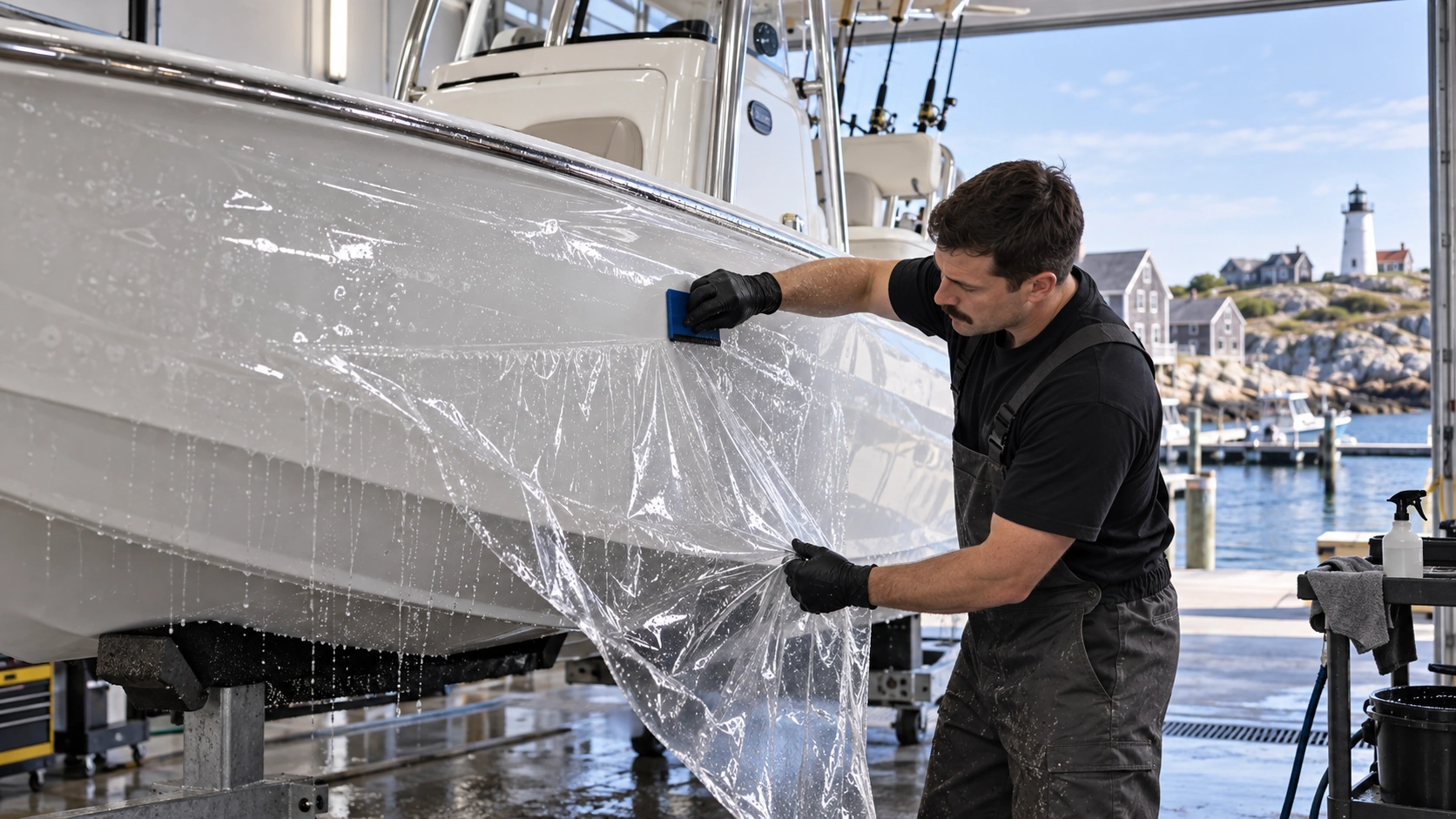
Marine paint protection film, also called marine PPF or boat PPF, is a clear protective film installed over selected boat surfaces.
It acts as a sacrificial layer between the boat finish and the abuse of normal use.
Instead of shoes, gear, ropes, fenders, docks, coolers, and swim traffic directly contacting the gelcoat or paint, those surfaces contact the film first.
Marine PPF is similar in concept to automotive paint protection film, but the marine environment is different.
Boats deal with salt, sun, water, ropes, docks, wet use, and high-contact zones that are very different from road driving.
The film needs to be placed where it makes sense.
What Marine PPF Helps Protect Against
Marine PPF helps protect against common physical wear.
That may include:
Dock rash.
Light scratches.
Scuffs.
Fender rub.
Rope rub.
Boarding wear.
Cooler contact.
Gear movement.
Shoe marks.
Swim platform abuse.
Transom scratches.
High-contact hull areas.
Fishing gear contact.
Trailer loading contact.
General wear from repeated use.
It does not make the boat impossible to damage.
But it helps reduce the visible wear that happens from normal boating.
For many owners, that is exactly the protection they need.
Why Boats Get Scratched So Easily
Boats are constantly touched by people and objects.
A car may sit parked most of the day. A boat is used differently.
People step on and off.
Kids climb over surfaces.
Coolers get dragged.
Fishing rods and tackle move around.
Fenders rub.
Lines tighten and loosen.
The boat shifts near docks.
Shoes carry sand.
Ladders and platforms get used all day.
Even careful use creates contact.
That repeated contact is what makes boats show wear.
Marine PPF is designed to help protect those contact areas.
Docking and exposed surfaces
Dock Rash Protection
Dock rash is one of the biggest reasons marine PPF is worth it.
Even a careful captain cannot control every dock contact situation.
Wind moves the boat.
Current moves the boat.
Wake moves the boat.
Tide changes the angle.
Fenders shift.
Lines stretch.
Other boats move.
A quick rub against a dock, piling, lift, or fender can leave visible marks on gelcoat or painted surfaces.
Marine PPF can help protect vulnerable areas from light dock contact and repeated rubbing.
This is especially useful on high-value boats, dark finishes, painted hulls, and areas that regularly sit near dock contact points.
Fender Rub Protection
Fenders protect the boat, but they can also create wear.
A fender sitting against the same area over and over can leave scuffs, dull spots, or rub marks.
This is especially common when boats are tied up for longer periods, docked in rough conditions, or used in busy marinas.
Marine PPF can help protect the surface where fenders contact the boat.
Instead of the fender rubbing directly against paint or gelcoat, it rubs against the film.
For boats that spend a lot of time at docks, this can be a smart use of PPF.
Rope Rub Protection
Ropes and lines can also create wear.
Dock lines, mooring lines, anchor lines, and tow lines can rub against surfaces during normal use.
Over time, repeated rubbing can mark the finish.
Marine PPF can be installed in selected areas where rope contact is common.
This is especially useful around cleats, gunnels, transoms, bow areas, and high-use zones where lines regularly touch the boat.
The goal is not to film every possible rope path.
The goal is to protect the areas where wear is predictable.
Swim Platform Protection
Swim platforms are one of the strongest areas for marine PPF.
They take constant abuse.
People climb in and out of the water.
Wet feet slide across the surface.
Kids jump, sit, and crawl.
Ladders move.
Coolers and bags get set down.
Water toys, ropes, boards, and gear get dragged across the area.
Even if the platform is not painted the same way as the hull, surrounding painted or gelcoat surfaces can show scratches and scuffs.
Marine PPF can protect selected platform areas, vertical faces, edges, and nearby high-contact zones.
For family boats and day boats, swim platform protection is often worth it.
Transom Protection
The transom is another common PPF area.
It is highly visible and often receives a lot of contact.
People board from the stern.
Swim ladders are used.
Ropes and fenders rub.
Fishing gear moves through the area.
Water toys and boards hit the back of the boat.
Dock contact often happens near the stern.
A scratched transom can make the boat look worn quickly.
Marine PPF can protect selected transom surfaces from scuffs, scratches, and repeated contact.
For painted transoms, dark gelcoat, and high-value boats, this can be a very practical upgrade.
Boarding Area Protection
Boarding areas take abuse because everyone uses them.
Shoes, sandals, bare feet, bags, coolers, pets, towels, fishing gear, and water toys all pass through the same zones.
Even careful passengers may drag something across the surface.
If the boarding area has painted or gelcoat surfaces, scratches and scuffs can happen quickly.
Marine PPF can protect those entry and exit points.
This is especially helpful on boats used by families, guests, renters, clients, or groups where not everyone is thinking about protecting the finish.
Gunnel Protection
Gunnels are high-contact areas on many boats.
People sit on them, lean over them, rest gear on them, place rods against them, and step near them.
Fishing boats, center consoles, day boats, and family boats can all see heavy gunnel use.
Marine PPF can help protect selected gunnel areas from scuffs, scratches, and repeated contact.
This is especially valuable where rods, reels, tackle, coolers, and docking lines come into contact with the surface.
For active-use boats, gunnel protection can make sense.
Bow Protection
The bow can also benefit from marine PPF depending on how the boat is used.
Anchoring, docking, beaching, mooring, boarding, and bow seating can all create contact.
Some boats see scratches near bow ladders, anchor areas, docking points, and front seating zones.
Marine PPF can protect selected bow areas where contact is common.
This is especially useful when the bow is used for boarding, anchoring, beaching, or passengers regularly climbing in and out.
The more the bow is used as an access point, the more protection makes sense.
Hull Side Protection
Hull sides can be vulnerable to dock contact, fenders, trailer contact, and repeated rubbing.
Not every hull needs full side protection, but certain zones may be worth protecting.
If a boat regularly docks on one side, sits in a slip, uses certain fender positions, or rubs near specific contact points, marine PPF can be targeted to those areas.
This is especially useful on painted hulls or dark gelcoat that shows marks more easily.
A targeted film layout can protect the most vulnerable sections without covering the whole boat.
Trailer Contact Protection
Trailering can create wear too.
Loading, unloading, bunks, rollers, guide posts, straps, and trailer contact points can all affect surfaces over time.
Marine PPF may be useful in areas where trailer contact is predictable and the surface is suitable for film.
This depends heavily on the boat, trailer, surface shape, and contact point.
A professional inspection is important.
Not every trailer wear area is a good film application, but some predictable contact zones can benefit from protection.
Boat type, condition and use
Fishing Boat Protection
Fishing boats are excellent candidates for targeted PPF.
Fishing creates a lot of contact.
● Rods.
● Reels.
● Tackle boxes.
● Coolers.
● Pliers.
● Knives.
● Gaffs.
● Nets.
● Hooks.
● Fish.
● Bait.
● Shoes.
● Dock lines.
Gear gets moved constantly, and scratches happen quickly.
Marine PPF can protect selected high-use areas where gear regularly contacts the boat.
For center consoles, bay boats, offshore boats, and sport fishing boats, PPF can be a practical protection layer.
Family Boat Protection
Family boats see different wear.
Kids climb in and out.
Friends bring bags, coolers, towels, water toys, and chairs.
People sit where they should not.
Feet drag over edges.
Dogs jump aboard.
Swim platforms get used all day.
Marine PPF can help protect the areas that get abused during normal family boating.
For family boats, the goal is not just appearance.
It is making the boat easier to enjoy without worrying about every scuff from a normal day on the water.
Wake Boat and Surf Boat Protection
Wake boats and surf boats are strong candidates for PPF because they see constant boarding, swimming, gear, and platform use.
Boards, ropes, ballast bags, coolers, life jackets, wet feet, and passengers all create contact.
The swim platform, transom, rear corners, boarding zones, and high-contact interior-facing surfaces may benefit from film.
These boats are built for activity, which means wear is part of the lifestyle.
Marine PPF helps protect the areas that see repeated use.
Center Console Protection
Center consoles deal with salt, gear, fishing, docking, and constant movement around the boat.
High-contact areas may include gunnels, transoms, hull sides, bow areas, console contact zones, and areas near rod holders or gear storage.
Marine PPF can protect selected areas from scratches and scuffs caused by normal use.
For center console owners who care about keeping the boat clean and presentable, targeted PPF can make a lot of sense.
It is especially useful on darker hulls and painted surfaces.
Cabin Cruiser Protection
Cabin cruisers often have more boarding areas, transoms, swim platforms, and high-contact surfaces.
Guests may board from docks, swim platforms, or side access points.
Gear, luggage, coolers, and supplies get moved on and off the boat.
Marine PPF can protect those entry points and contact zones.
For cabin cruisers, PPF often makes the most sense around boarding areas, stern zones, transoms, and any painted or gelcoat surfaces that see repeated contact.
Yacht and Tender Protection
Yachts and tenders often benefit from targeted protection.
A tender may get heavy dock contact, boarding contact, and beach use.
A yacht may have high-visibility areas that need to stay clean and protected.
Marine PPF can help reduce scuffs and scratches in selected areas.
On high-end boats, even small wear can stand out.
Protecting transoms, boarding zones, tender contact points, swim platforms, and fender areas can help preserve the appearance of the boat.
Painted Boat Protection
Painted boats often benefit strongly from marine PPF.
Paint can show scratches, scuffs, dock rash, and fender rub more obviously than some gelcoat surfaces.
Dark painted finishes can be especially unforgiving.
Marine PPF can protect selected painted areas from common physical wear.
This is useful for painted hull sides, transoms, accent areas, custom paint, and high-contact surfaces.
For painted boats, PPF is often easier to justify because repairs can be expensive and visible wear stands out quickly.
Gelcoat Protection
Gelcoat is durable, but it is not immune to scratches, scuffs, oxidation, and dock contact.
Marine PPF can protect selected gelcoat areas from physical wear.
This is especially useful on dark gelcoat, high-gloss gelcoat, newer boats, recently restored boats, and high-contact surfaces.
The film acts as a sacrificial layer.
If the area gets rubbed or scuffed, the film takes the abuse first.
For gelcoat owners, PPF can help reduce the amount of visible wear in key areas.
Dark Hull Protection
Dark hulls look great, but they show damage more easily.
Scratches, scuffs, water spots, dock rash, and fender marks tend to stand out more on dark surfaces.
Marine PPF can protect high-contact dark hull areas from repeated wear.
This is useful around docks, fender contact points, boarding areas, transoms, and hull sides that see regular contact.
For dark boats, targeted PPF can help preserve the clean look longer.
The darker the finish, the more obvious contact damage can be.
New Boat Protection
New boats are strong candidates for marine PPF.
A new boat may look perfect at delivery, but normal use starts immediately.
Docking.
Boarding.
Cleaning.
Trailering.
Swimming.
Fishing.
Loading gear.
Moving coolers.
All of those create opportunities for scratches and scuffs.
Installing marine PPF early protects the high-contact areas before damage begins.
For new boat owners, this can be one of the smartest times to add film because the surfaces are usually in better condition and easier to protect.
Used Boat Protection
Used boats can also benefit from PPF, but prep matters.
If the surface already has scratches, oxidation, staining, old wax, or damage, it may need cleaning, polishing, correction, or repair before film is installed.
PPF does not hide every existing flaw.
It protects what is underneath it.
For used boats, the process usually starts with inspection.
Which areas are worth protecting?
Which areas need prep?
Which surfaces are suitable for film?
A good plan protects the boat realistically based on its current condition.
Recently Detailed Boat Protection
Marine PPF makes sense after detailing or surface correction.
If the boat has been polished, restored, or cleaned up, film can help preserve the areas most likely to get scuffed again.
This is especially useful for high-contact transoms, swim platforms, boarding areas, hull sides, and gunnels.
A detailed boat can start showing wear again quickly once it goes back into use.
PPF helps protect that investment by adding a sacrificial layer to the vulnerable zones.
Restored Boat Protection
Restored boats can be excellent candidates for marine PPF.
If a boat has been repainted, gelcoat corrected, polished, or brought back to life, protecting high-contact areas helps preserve the work.
Older boats may also have limited replacement parts or custom finishes that are harder to repair.
Marine PPF can help protect selected areas without changing the character of the boat.
For restored boats, the key is surface condition and proper film placement.
The better the prep, the better the result.
Plan coverage and compare products
Where Marine PPF Makes the Most Sense
Marine PPF is most valuable in areas that see repeated contact.
That usually includes:
Swim platforms.
Transoms.
Boarding zones.
Steps.
Gunnels.
Bow access areas.
Dock contact zones.
Fender rub zones.
Rope rub zones.
Hull sides near slips.
Trailer contact areas.
Gear loading areas.
Fishing equipment contact areas.
The exact layout depends on the boat.
A good marine PPF plan is customized around how the boat is used.
Where Marine PPF May Not Be Necessary
Not every surface needs film.
Areas that rarely get touched, rubbed, stepped on, or exposed to contact may not need PPF.
For some boats, a targeted package is smarter than a broad film installation.
Marine ceramic coating may be a better option for large surfaces where the goal is easier cleaning, gloss, and UV resistance.
PPF is best for physical contact.
Coating is best for maintenance and surface behavior.
The right protection plan may use both in different areas.
Marine PPF vs Ceramic Coating
Marine PPF and ceramic coating are not the same.
Marine PPF is a physical film that helps protect against scratches, scuffs, dock rash, and abrasion.
Marine ceramic coating is a liquid-applied coating that helps with gloss, slickness, easier cleaning, salt cleanup, and surface maintenance.
PPF is better for contact zones.
Ceramic coating is better for broad maintenance.
If your biggest concern is dock rash, scratches, or gear damage, PPF is the stronger choice.
If your biggest concern is cleaning and gloss, coating may be the better choice.
Many boat owners choose both.
Marine PPF vs Wax
Wax can help add gloss and short-term protection, but it does not provide the same physical protection as PPF.
A waxed surface can still scratch from dock contact, fender rub, shoes, coolers, and gear.
Marine PPF adds a thicker physical barrier in selected areas.
Wax is a maintenance product.
PPF is a protection layer.
They solve different problems.
If the concern is physical wear, PPF is the more appropriate solution.
Marine PPF vs Vinyl Wrap
Marine PPF and vinyl wrap are also different.
Vinyl wrap is mainly used for color, style, graphics, branding, or appearance changes.
PPF is designed for protection.
A vinyl wrap can still scratch, tear, stain, or wear.
Marine PPF is the better choice when the main goal is protecting paint or gelcoat from contact.
For boat owners who want graphics or color change, vinyl may have a role.
For high-contact protection, PPF is usually the stronger product.
Marine PPF vs Gelcoat Repair
Gelcoat repair can fix certain damage after it happens, but repair takes time and can be costly depending on the damage and finish.
Marine PPF is preventive.
It helps reduce the chance that common contact creates visible damage in the first place.
For high-contact areas, preventing damage is usually easier than fixing it later.
PPF does not replace repair work for existing damage, but it can help protect clean or restored surfaces going forward.
Marine PPF and Ceramic Coating Together
Marine PPF and ceramic coating can work well together.
PPF protects selected high-contact areas.
Ceramic coating helps broader surfaces clean more easily and maintain gloss.
This is often the best approach for owners who want protection and easier maintenance.
For example, a boat may receive PPF on the transom, swim platform edges, boarding areas, and fender rub zones, then ceramic coating on larger gelcoat or painted surfaces.
The film handles physical abuse.
The coating helps with cleaning and gloss.
Marine PPF and Window Film Together
Marine PPF and marine window film also solve different problems.
PPF protects painted or gelcoat surfaces from physical wear.
Window film helps reduce heat, glare, UV exposure, and privacy concerns through glass.
A boat with a cabin, salon, enclosed helm, or large glass may benefit from window film.
The same boat may benefit from PPF on transoms, boarding areas, and dock contact zones.
Together, they improve both protection and comfort.
Care, conditions and ownership
Marine PPF and Cleaning
Marine PPF can make protected areas easier to care for because the surface underneath is shielded from direct scuffs and wear.
However, the film still needs to be cleaned properly.
Salt, grime, sunscreen, bird droppings, and dirt should still be removed.
Film should be cared for with appropriate products and gentle washing methods.
Marine PPF is not a reason to ignore maintenance.
It is a way to make high-contact areas more forgiving and help preserve the finish underneath.
Marine PPF and Salt Exposure
Salt exposure is part of boating in Massachusetts and Rhode Island.
Salt can dry on surfaces and contribute to grime, staining, and cleaning difficulty.
Marine PPF protects the underlying surface in covered areas, but the film itself still needs to be rinsed and cleaned.
After saltwater use, regular rinsing and washing are still important.
The value of PPF is that repeated contact and cleaning affect the film first, not the boat finish underneath.
For saltwater boats, that sacrificial layer can be valuable.
Marine PPF and Sun Exposure
Sun exposure is another major marine challenge.
Boats sit in open sun for long periods, and sunlight reflects off water and bright surfaces.
Marine PPF is designed to protect against physical wear, but product choice and maintenance still matter in high-UV environments.
A good marine protection plan may also include ceramic coating and window film depending on the surfaces.
PPF protects contact zones.
Coating helps with broad surface maintenance.
Window film helps with heat and glare through glass.
Sun exposure should be part of the overall protection conversation.
Marine PPF and Waterline Grime
Marine PPF is not usually the main answer for waterline grime.
Ceramic coating is often a better fit for surfaces where easier cleaning, slickness, and grime release are the goal.
PPF may still be used in contact areas near the waterline if physical wear is the concern.
The right product depends on the problem.
If the issue is repeated rubbing, PPF may help.
If the issue is staining and cleaning, ceramic coating may be better.
A proper inspection helps decide.
Marine PPF and Existing Damage
Marine PPF should not be viewed as a way to hide existing damage.
If the boat already has scratches, oxidation, chips, staining, gouges, or dock rash, those issues may still be visible under the film.
The surface may need prep, repair, or correction first.
PPF protects the surface condition you install it over.
That is why new boats, recently detailed boats, and corrected surfaces are often the best candidates.
For damaged areas, the right first step may be repair or polishing before film.
Marine PPF and High-Gloss Finishes
High-gloss finishes can show scratches and scuffs quickly.
Marine PPF can help protect those finishes in areas where contact is predictable.
This is useful on high-gloss gelcoat, painted hulls, custom paint, black surfaces, dark blue hulls, and polished surfaces.
The film helps preserve the look by taking the abuse first.
For owners who care about the finish, targeted PPF can reduce the stress of normal use.
Marine PPF and Matte or Satin Finishes
Matte and satin finishes require extra care because damage and repairs can be more difficult to blend.
If a matte or satin painted area gets scratched, polished repair may not be simple.
Marine PPF may be worth discussing for high-contact matte or satin areas, but product selection and appearance matching matter.
Not every film or surface combination is appropriate.
A professional installer should evaluate the surface and discuss expectations before installation.
Marine PPF for Boats Stored in Slips
Boats stored in slips may see repeated contact in predictable areas.
Fenders rub.
Lines pull.
The boat shifts with wind, current, wake, and tide.
Neighbors dock nearby.
Dock contact zones can become obvious over time.
Marine PPF can be targeted to the areas that see slip-related wear.
For boats that stay in the water during the season, this can be a practical way to reduce recurring scuffs and rub marks.
Marine PPF for Trailered Boats
Trailered boats face different wear.
Loading, unloading, straps, guide posts, docks, ramps, and gear movement all create contact.
The boat may also be used in different locations, which increases unknown docking situations.
Marine PPF can protect selected areas that see repeated loading, boarding, and ramp use.
For trailer boat owners, the best protection plan depends on how the boat is launched, loaded, and used.
Marine PPF for Marina Boats
Marinas create more contact risk.
Boats are closer together.
Docks are busy.
Fenders are used constantly.
Guests board often.
Wind and wake move boats around.
Marine PPF can help protect high-contact dock and fender zones.
For boat owners who keep their boat in a marina, targeted protection can make sense.
It helps reduce the small marks that build up during a normal season.
Marine PPF for Boats Used Around Sandbars
Sandbar days can be rough on a boat.
People climb in and out.
Sand gets everywhere.
Coolers move around.
Inflatables, boards, towels, chairs, and bags get dragged across surfaces.
Swim platforms and boarding zones take heavy use.
Marine PPF can help protect those high-contact areas from scuffs and scratches.
For family boats and social boats used at sandbars, PPF can be a smart upgrade.
Marine PPF for Boats With Kids and Pets
Kids and pets are not gentle on boat surfaces.
Wet feet, sandy shoes, claws, toys, life jackets, towels, snacks, and constant movement can create wear.
Marine PPF can help protect the areas where people and pets climb, sit, step, and move gear.
This does not mean owners need to worry less about safety or care.
It simply adds a protective layer in the places most likely to get marked up.
For family boats, this can be worth it.
Marine PPF for Charter or Business Boats
Charter boats, rental boats, tour boats, work boats, and business-use vessels can benefit from marine PPF because they see more users.
More users usually means more contact.
Customers and guests may not treat the boat the same way the owner would.
High-contact areas can wear quickly.
Marine PPF can protect boarding zones, transoms, gunnels, steps, and other surfaces that see constant use.
For business boats, reducing cosmetic wear can help maintain a more professional appearance.
Marine PPF and Resale Value
Marine PPF can help preserve the appearance of high-contact areas, which may support resale presentation.
A boat with fewer scratches, scuffs, and dock rash in visible areas is easier to show and easier to feel confident about.
This does not guarantee a higher resale value, but condition matters when selling a boat.
Protection helps reduce preventable wear.
For newer or high-value boats, preserving condition can be part of the ownership plan.
Choose and maintain your coverage
Is Marine PPF Worth It for Every Boat?
Marine PPF is not necessary for every boat.
If the boat is older, heavily worn, low-value, rarely used, or the owner does not care about cosmetic wear, PPF may not be worth it.
If the boat is new, high-value, dark-colored, painted, freshly detailed, heavily used, stored at a marina, used by family, or prone to dock contact, PPF is much easier to justify.
The best answer depends on the boat and how it is used.
Marine PPF is most worth it when the protected areas are likely to be damaged.
How Much Marine PPF Should You Install?
Most boats do not need film everywhere.
A targeted package is usually the smartest approach.
Start with the areas most likely to get scuffed.
Transom.
Swim platform.
Boarding areas.
Dock contact zones.
Fender rub zones.
Rope rub zones.
Gunnels.
Bow access areas.
Gear loading areas.
From there, decide whether additional areas are worth protecting.
The right amount of film depends on use, budget, finish, and risk.
Professional Installation Matters
Marine PPF installation requires careful surface prep and planning.
Boat surfaces can be curved, textured, contoured, and interrupted by hardware.
Cleats, ladders, rails, rub rails, vents, hinges, trim, steps, and edges all affect installation.
The surface must be clean and suitable for film.
The film layout should be planned around real contact points.
Professional installation matters because the finished result should protect the boat while looking clean and intentional.
A poor install can create more frustration than protection.
Surface Prep Matters
Marine PPF is only as good as the surface underneath it.
Old wax, oxidation, salt, grime, silicone, stains, water spots, and contamination can affect installation.
Painted or gelcoat surfaces may need cleaning or polishing before film.
Damaged areas may need repair first.
If film is installed over poor surface condition, the result may not look or perform as intended.
That is why inspection and prep are important.
Protection works best when the surface is properly prepared.
What to Expect After Marine PPF Installation
After marine PPF installation, the film may need time to settle and cure depending on conditions.
Small moisture pockets or temporary visual changes may be present during the early stage.
The boat should be cared for according to installer instructions.
Avoid aggressive cleaning, harsh chemicals, pressure washing edges too closely, or picking at edges.
Marine use is demanding, so proper aftercare matters.
A good installer should explain what is normal and how to maintain the film.
How to Care for Marine PPF
Marine PPF should be rinsed and cleaned regularly, especially after saltwater use.
Use gentle wash methods and products that are safe for the film.
Avoid harsh abrasives, aggressive scrubbing, and strong chemicals unless approved for the product.
Do not aim high-pressure water directly at film edges from close distance.
Keep the film clean from salt, sunscreen, fuel residue, grime, bird droppings, and stains.
Marine PPF is protective, but it still needs care.
Proper maintenance helps it look better and last longer.
Questions to Ask Before Installing Marine PPF
Before installing marine PPF, ask:
Where does the boat get scuffed most often?
Does the boat rub docks, fenders, ropes, or pilings?
Do people board from the swim platform, side, or bow?
Is the transom high-contact?
Is the boat painted, gelcoat, matte, satin, or dark-colored?
Is the boat new, used, restored, or recently detailed?
Does the boat stay in a slip or get trailered?
Is dock rash already present?
Are there areas where gear, coolers, or fishing equipment rub?
Should ceramic coating be added for easier cleaning?
Should window film be added for glare and heat?
These answers help build the right protection plan.
Final Thoughts
Marine paint protection film is worth it for boat owners who want to protect high-contact areas from dock rash, scratches, scuffs, fender rub, rope rub, boarding wear, swim platform abuse, and repeated use.
It is especially valuable on new boats, high-value boats, painted boats, dark hulls, family boats, fishing boats, wake boats, center consoles, cabin cruisers, and boats stored in slips or used frequently.
At Kickin’ Customs in Raynham, MA, we install marine PPF for boat owners across Massachusetts, Rhode Island, Cape Cod, South Coast, Buzzards Bay, Plymouth, Dartmouth, Fall River, New Bedford, Wareham, and surrounding boating areas.
The best marine PPF plan is targeted.
Protect the areas that take the abuse.
Use ceramic coating where easier cleaning and gloss matter.
Use marine window film where heat, glare, and comfort matter.
Together, these products can help keep your boat cleaner, better protected, and easier to enjoy.
Frequently Asked Questions
Is marine paint protection film worth it for boats?
Yes, marine PPF can be worth it for boats with high-contact areas, dock rash concerns, painted surfaces, dark hulls, swim platforms, transoms, and frequent use.
What areas of a boat should get marine PPF?
Common marine PPF areas include swim platforms, transoms, boarding areas, gunnels, bow access points, dock contact zones, fender rub zones, rope rub zones, and gear loading areas.
Does marine PPF stop dock rash?
Marine PPF can help protect against light dock rash, fender rub, rope rub, and repeated contact, but it does not make the boat impossible to damage.
Can marine PPF protect gelcoat?
Yes, marine PPF can protect selected gelcoat areas from scratches, scuffs, and contact wear when installed on suitable prepared surfaces.
Can marine PPF protect painted boats?
Yes. Painted boats are strong candidates for marine PPF because scratches, scuffs, and dock rash can be more visible and costly to repair.
Is marine PPF better than ceramic coating?
It depends on the problem. PPF is better for physical contact and scratches. Ceramic coating is better for gloss, slickness, easier cleaning, and salt cleanup.
Does marine PPF eliminate boat maintenance?
No. Marine PPF still needs regular rinsing and cleaning, especially after saltwater use.
Should marine PPF be installed on a new boat?
Yes, new boats are great candidates because the film can protect high-contact areas before dock rash, scratches, and scuffs begin.
Plan your next step
Want to protect your boat’s high-contact areas before scratches, scuffs, and dock rash take over? Contact Kickin’ Customs in Raynham, MA to compare marine PPF options for transoms, swim platforms, boarding zones, hull sides, fender rub areas, and painted or gelcoat surfaces.
