
The short answer
Boats live in a harsh environment.
● Sun.
● Saltwater.
● Brackish water.
● Freshwater.
● Dock spray.
● Bird droppings.
● Fish blood.
● Water spots.
● Oxidation.
● Scum lines.
● Fenders.
● Mildew.
● Foot traffic.
● Cleaning chemicals.
● Seasonal storage.
Even a well-maintained boat takes constant work to keep clean.
That is why many boat owners ask about ceramic coating for boats.
A marine ceramic coating can help make the boat easier to clean, improve water behavior, enhance gloss, and add a protective layer to compatible surfaces.
It does not make the boat maintenance-free.
It does not stop every scratch.
It does not replace washing.
It does not fix neglected gelcoat by itself.
But when properly installed on the right surfaces, ceramic coating can make ownership easier and help keep the boat looking better through the season.
At Kickin’ Customs in Raynham, MA, we install marine ceramic coatings, marine window tint, marine paint protection film, and related surface protection services for boat owners across Massachusetts, Rhode Island, Cape Cod, Buzzards Bay, Plymouth, Dartmouth, New Bedford, Fall River, Wareham, and surrounding coastal areas.
If you want easier cleanup and better surface protection for your boat, ceramic coating is worth considering.
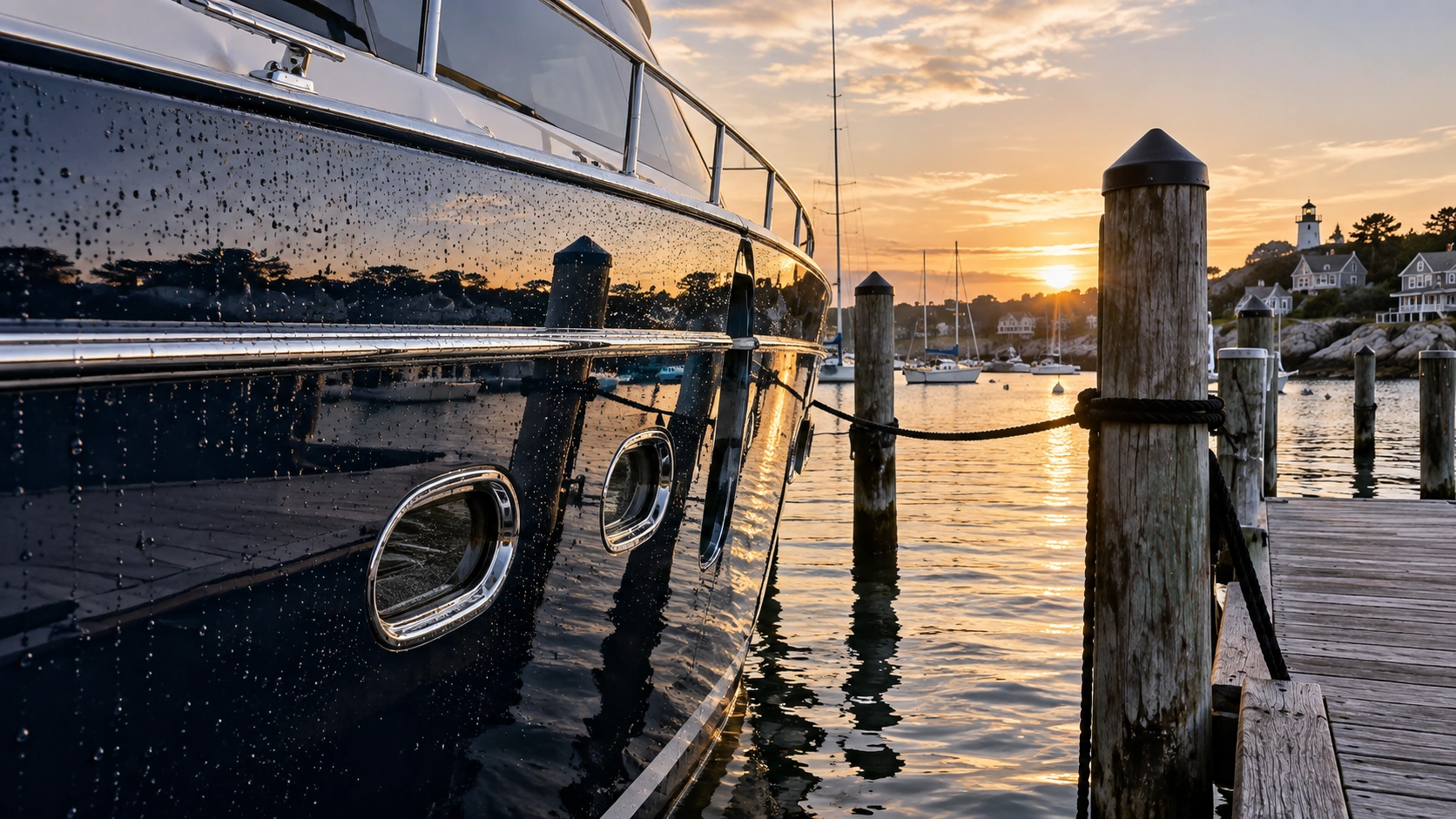
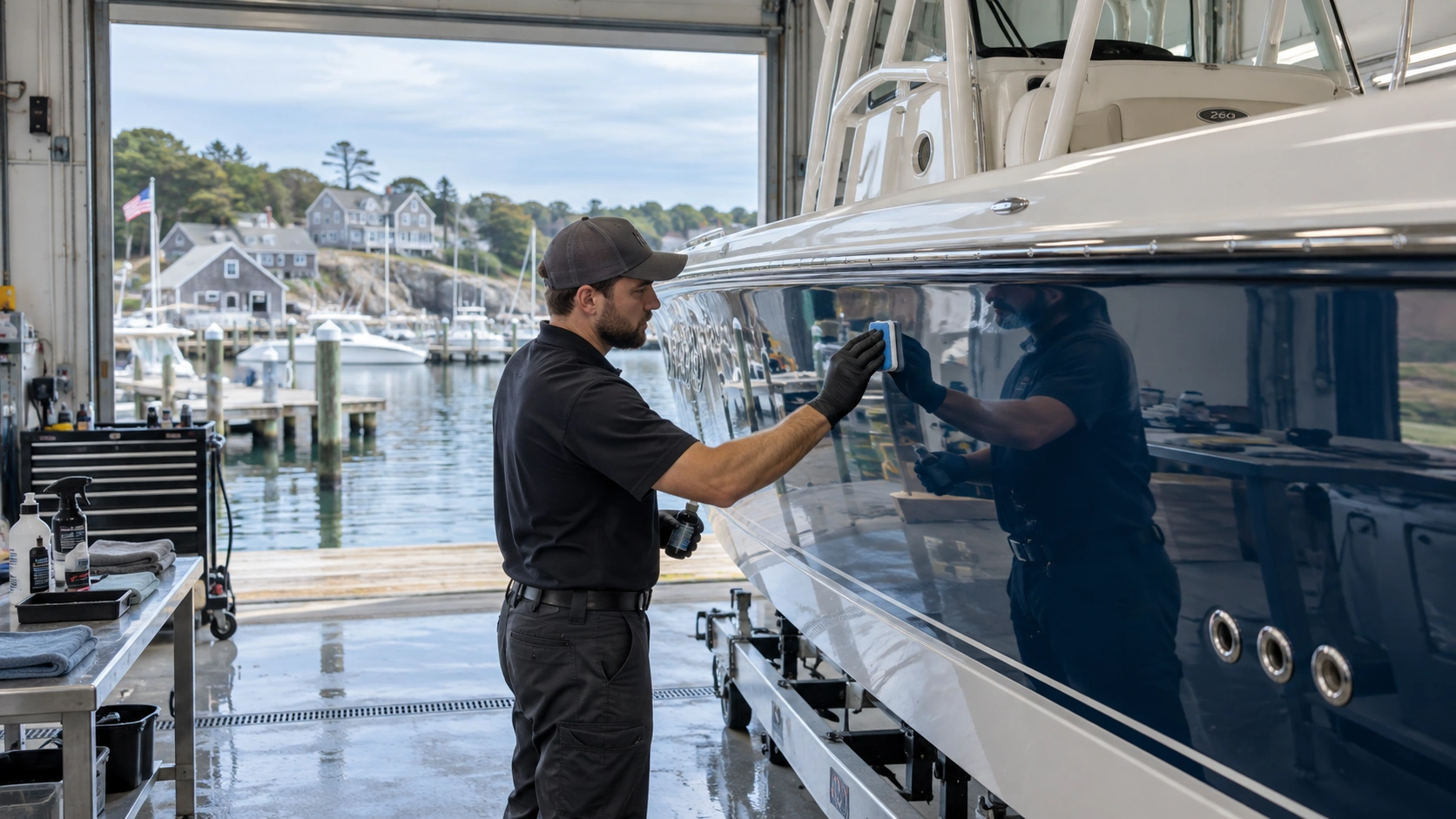
Marine imagery shown in this guide is illustrative.
Coating benefits and limits
What Is Ceramic Coating for Boats?
Ceramic coating is a liquid protective coating applied to properly prepared surfaces.
Once installed and cured, it creates a slick, hydrophobic surface that helps repel water, dirt, salt, grime, and other contaminants.
On boats, ceramic coating is commonly used on gelcoat, painted surfaces, topsides, hull sides, metal, glass, and other compatible surfaces depending on the product and application.
The main goal is easier maintenance.
A ceramic-coated boat is usually easier to wash than an uncoated surface because contaminants have a harder time sticking.
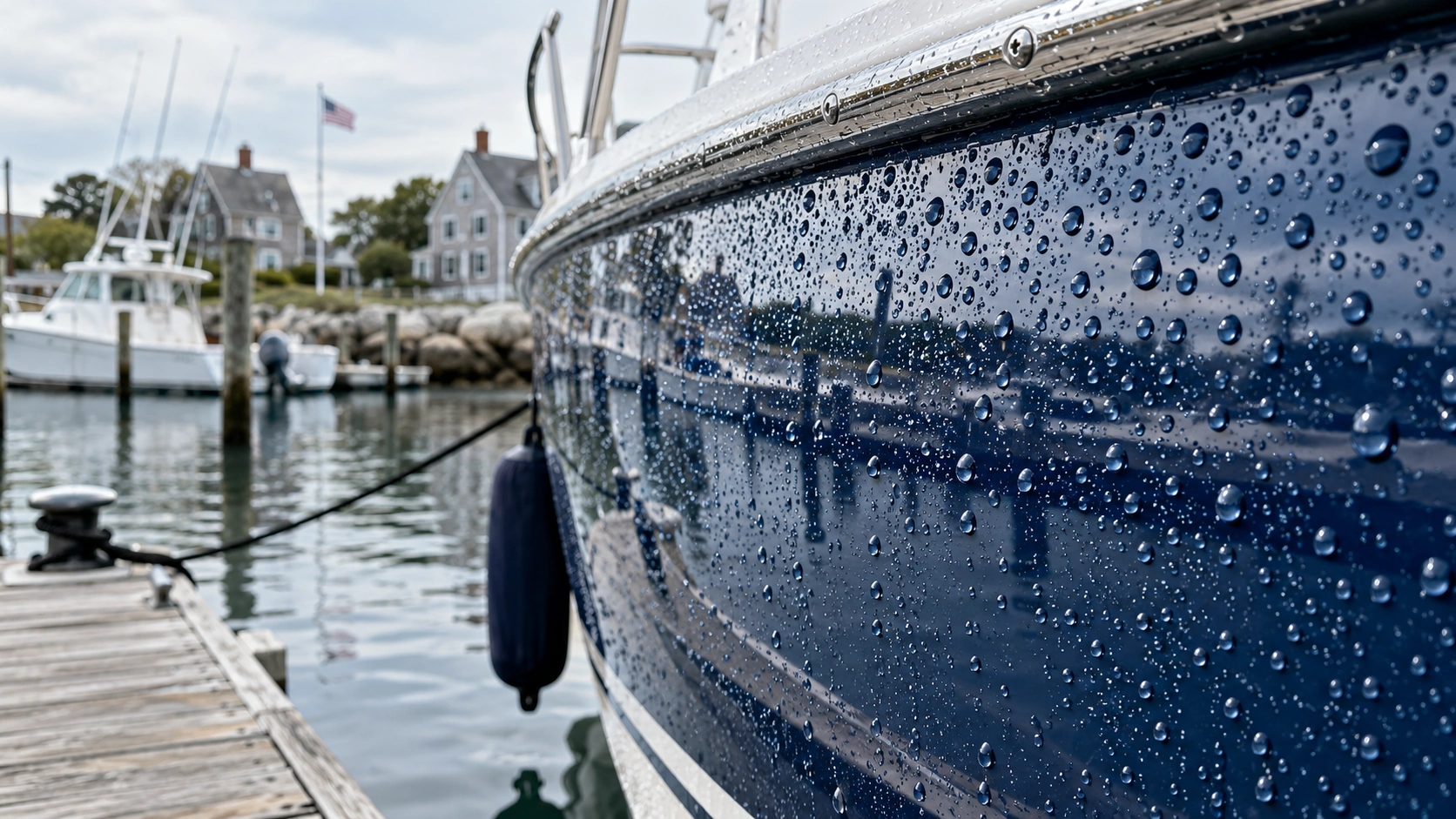
Water tends to bead and release more easily.
Salt and surface grime may clean off with less effort.
Gloss and depth can improve when the surface is properly prepared before coating.
For boat owners, that can make a big difference during the season.
Why Boats Are Hard to Keep Clean
Boats are harder to keep clean than cars for one simple reason:
They are surrounded by water and exposed to sun for hours at a time.
Saltwater dries on surfaces.
Hard water leaves spots.
Algae and scum can collect along the waterline.
Bird droppings can bake in the sun.
Fish blood and bait residue can stain if left too long.
Dock spray can leave mineral buildup.
Foot traffic can grind dirt into surfaces.
UV exposure can dull gelcoat over time.
A boat may look great after a detail, but the environment starts attacking it again immediately.
Ceramic coating helps by making many surfaces easier to clean and maintain.
It does not stop the environment.
It makes cleanup less of a fight.
Ceramic Coating Is Not Wax
Marine wax and ceramic coating are not the same.
Wax sits on the surface and provides temporary gloss and water behavior.
It can look good, but it usually wears down faster, especially in sun, salt, washing, and water exposure.
Ceramic coating bonds more durably to the prepared surface and is designed to last longer than a traditional wax or basic sealant.
That does not mean wax is useless.
Many boat owners have used wax for years.
But ceramic coating is the stronger modern option when the owner wants longer-lasting surface protection and easier cleaning.
For boats that are used often, stored outside, or exposed to saltwater, a ceramic coating can make seasonal maintenance more manageable.
Ceramic Coating Is Not Paint Protection Film
Ceramic coating and marine paint protection film are different products.
Ceramic coating helps with slickness, water behavior, gloss, cleanup, and surface contamination.
Paint protection film helps protect high-contact areas from physical wear, scratches, scuffs, docks, fenders, gear, and certain abrasion.
A ceramic coating does not absorb impacts like PPF.
It does not stop dock rash.
It does not protect against deep scratches.
It does not prevent gouges from gear, lines, anchors, or fenders.
Marine PPF is the better layer for physical wear areas.
Ceramic coating is the better layer for easier cleaning and overall surface maintenance.
Many boats can benefit from both.
What Marine Ceramic Coating Helps With
Marine ceramic coating can help with several common boat ownership problems.
It can help water bead and release more easily.
It can make saltwater cleanup easier.
It can reduce how strongly grime sticks to compatible surfaces.
It can improve gloss and depth on properly prepared gelcoat or painted surfaces.
It can help reduce UV exposure effects on coated surfaces.
It can make water spots easier to address when maintained properly.
It can make seasonal washing and maintenance less frustrating.
It can help keep topsides and hull sides looking cleaner.
It can protect certain metal and glass surfaces when the correct coating is used.
The biggest benefit is not that the boat never gets dirty.
The biggest benefit is that the boat is easier to clean when it does.
What Marine Ceramic Coating Does Not Do
Ceramic coating is useful, but it has limits.
It does not make the boat maintenance-free.
It does not stop all oxidation.
It does not restore heavily oxidized gelcoat without prep.
It does not replace washing.
It does not prevent barnacles or marine growth below the waterline.
It does not replace bottom paint.
It does not stop dock rash.
It does not stop fender scuffs.
It does not stop deep scratches.
It does not make non-skid surfaces safe to coat automatically.
It does not prevent every water spot.
It does not remove the need for seasonal maintenance.
Ceramic coating is a maintenance and surface-protection tool.
It should be explained honestly.
Surfaces and compatibility
Where Ceramic Coating Makes Sense on a Boat
Ceramic coating can make sense on several boat surfaces, depending on the material and condition.
● Common areas include:
● Hull sides.
● Topsides.
● Gelcoat.
● Painted surfaces.
● Hardtops.
● Console surfaces.
● Cabin sides.
● Metal trim.
● Stainless rails.
● Glass.
Certain smooth fiberglass areas.
Certain smooth interior or exterior surfaces.
The correct coating and prep will depend on the surface.
Not every material should be treated the same.
A hull side is different from a non-skid deck.
Glass is different from gelcoat.
Stainless is different from painted metal.
A professional installer should evaluate each surface before coating.
Ceramic Coating for Hull Sides
Hull sides are one of the most common areas for marine ceramic coating.
They are highly visible.
They take constant sun exposure.
They collect water spots, salt, scum, and grime.
They are cleaned often.
A coated hull side can be easier to wash and maintain.
Water can bead more aggressively.
Salt and surface grime may release more easily.
Gloss can improve when the gelcoat or paint is properly polished before coating.
For boat owners who want their boat to look better at the dock and clean up easier after use, hull side coating is one of the best applications.
It is especially useful for darker hulls that show water spots and dullness more easily.
Ceramic Coating for Topsides
Topsides can also benefit from ceramic coating.
These areas are exposed to sun, salt spray, water spots, bird droppings, pollen, dirt, and regular cleaning.
A ceramic coating can help make topside surfaces easier to wash and keep clean.
This can include smooth fiberglass, painted surfaces, cabin sides, hardtops, exterior seating surrounds, and other compatible areas.
The key word is compatible.
The surface should be evaluated before coating.
Textured areas, high-traffic areas, or traction-focused surfaces need special caution.
A coating that works well on smooth gelcoat may not be appropriate everywhere.
Topsides often need a surface-by-surface plan.
Ceramic Coating for Gelcoat
Gelcoat is common on boats, and it can benefit from ceramic coating when properly prepared.
Gelcoat can oxidize, fade, chalk, and lose gloss over time.
A ceramic coating does not magically fix neglected gelcoat.
Prep matters.
If the gelcoat is oxidized, dull, or stained, it may need compounding, polishing, or correction before coating.
The coating locks in the condition of the surface.
If the boat is coated over dull gelcoat, the result will still be limited.
If the gelcoat is properly cleaned, polished, and prepared, ceramic coating can enhance gloss and make ongoing maintenance easier.
The coating is only as good as the prep underneath it.
Ceramic Coating for Dark Hulls
Dark hulls look incredible when they are clean, but they show everything.
● Water spots.
● Salt streaks.
● Oxidation.
● Swirls.
● Dock marks.
● Fender rub.
● Dullness.
A ceramic coating can be especially useful on dark hull sides because it improves slickness, gloss, and water behavior.
It can make washing easier and help reduce how strongly contaminants bond to the surface.
However, dark boats still require careful maintenance.
A coating does not make a dark hull immune to scratches, water spots, or poor washing habits.
It helps.
It does not replace proper care.
For black, navy, dark blue, burgundy, or dark green hulls, ceramic coating is usually worth discussing.
Ceramic Coating for White Boats
White boats may hide some defects better than dark boats, but they still get dirty.
White gelcoat can show scum lines, rust stains, bird droppings, mildew, black streaks, and dock grime.
A ceramic coating can make those contaminants easier to clean from compatible smooth surfaces.
It can also help maintain gloss and reduce chalky appearance when the surface is properly prepared.
White boats often benefit from coating because they are washed often and exposed constantly.
The owner may not be chasing deep color reflection like a dark hull owner, but they still want easier cleanup.
For white boats, the maintenance benefit is often the biggest reason to coat.
Ceramic Coating for Metal
Boats have a lot of metal.
● Stainless rails.
● Cleats.
● Rod holders.
● Towers.
● T-tops.
● Hardware.
● Ladders.
● Trim.
● Rub rail components.
Metal surfaces can collect salt, water spots, oxidation, and staining.
A ceramic coating designed for metal may help make these surfaces easier to clean and maintain.
It can help reduce how strongly salt and grime stick to the surface.
This does not mean metal never needs attention.
Stainless steel can still stain or rust if neglected, especially in saltwater.
But a coating can help support maintenance.
For saltwater boats, metal coating is a practical add-on when the owner wants easier cleanup.
Ceramic Coating for Glass
Glass coating is another useful marine option.
Boat glass takes a beating from salt spray, hard water, sun, and constant cleaning.
A glass coating can improve water behavior and make glass easier to clean.
This can be useful for windshields, cabin glass, side windows, and other compatible marine glass.
Good visibility is important on the water, so glass maintenance matters.
A glass coating does not replace wipers, proper cleaning, or safe visibility habits.
It also does not remove the need to rinse salt away.
But it can make water and grime release more easily.
For boats with large glass areas, marine glass coating is worth discussing.
Ceramic Coating for Non-Skid Surfaces
Non-skid surfaces need special caution.
The purpose of non-skid is traction.
A coating that adds slickness to smooth surfaces may not be appropriate for every traction area.
Boat owners should never assume every deck surface should be coated the same way as hull sides or gelcoat.
Some non-skid areas may be left untreated.
Some may require a specific product.
Some may need a test area.
Some may need to be avoided for safety.
This is an important part of marine coating conversations.
A boat should be easier to clean, but it should not become unsafe to walk on.
Traction matters.
Professional product selection matters.
Ceramic Coating for Swim Platforms
Swim platforms are high-use areas.
They deal with water, bare feet, sunscreen, salt, shoes, boarding, ladders, gear, and constant contact.
Some swim platform surfaces may be smooth.
Others may have non-skid or textured traction.
Ceramic coating may make sense on certain smooth areas, but traction-focused surfaces need caution.
If the surface becomes too slick, that creates a safety concern.
A professional installer should evaluate the material before coating.
For swim platforms, the goal is easier cleaning without compromising grip.
In some cases, marine PPF or a different surface protection option may be more appropriate than coating.
Ceramic Coating for Hardtops
Hardtops can benefit from ceramic coating because they are constantly exposed to sun, salt, bird droppings, water spots, and environmental fallout.
A hardtop is not always easy to clean, especially on larger boats.
A ceramic coating can make washing easier and help contaminants release more readily.
This can be especially useful for white fiberglass hardtops that collect black streaks, salt, and bird mess.
Prep still matters.
If the hardtop is oxidized or stained, it should be properly cleaned and corrected before coating.
Once coated, maintenance becomes easier, but the owner still needs to rinse and wash the surface regularly.
Ceramic Coating for Consoles
Center consoles, helm areas, and exterior cabin surfaces can benefit from ceramic coating when compatible.
These areas are exposed to hands, sunscreen, salt spray, water spots, electronics, fish blood, bait, and cleaning products.
A coating can improve surface slickness and make routine wipe-downs easier.
This can be helpful on smooth fiberglass console surfaces and certain painted or gelcoat areas.
However, care should be taken around electronics, textured controls, switches, vinyl, upholstery, rubber, and non-coated materials.
Not everything around the helm should be treated with the same coating.
The installer should protect sensitive areas and choose the right product for each surface.
Ceramic Coating for Painted Boats
Some boats have painted hulls or painted surfaces instead of traditional exposed gelcoat.
These surfaces can often be coated, but they need careful evaluation.
Painted marine surfaces may require different prep than gelcoat.
They may be softer, more delicate, or require specific products and techniques.
Polishing and correction should be approached carefully.
If the paint has existing defects, oxidation, scratches, or staining, those issues should be addressed before coating.
A ceramic coating can help improve gloss and maintenance, but it does not repair damaged paint by itself.
For painted boats, professional prep and product selection are especially important.
Ceramic Coating for Vinyl, Upholstery, and Canvas
Boat owners often ask whether every surface can be coated.
Vinyl, upholstery, canvas, and soft surfaces are different from gelcoat and metal.
They may require different protection products or may not be appropriate for a standard ceramic coating.
Seat cushions, canvas tops, enclosures, covers, bolsters, and upholstery need a separate conversation.
The wrong product can create appearance, texture, adhesion, or maintenance issues.
A marine coating project should be surface-specific.
Smooth gelcoat, glass, metal, vinyl, canvas, and non-skid surfaces should not all be treated the same.
Professional guidance matters because boats use many materials in one space.
Salt, sun and seasonal care
Ceramic Coating and Saltwater Cleanup
Saltwater cleanup is one of the biggest reasons to ceramic coat a boat.
Salt dries quickly and leaves residue.
If ignored, it can contribute to dullness, staining, corrosion, and surface buildup.
A ceramic coating can make salt residue easier to rinse and wash away from compatible coated surfaces.
That does not mean the owner can skip rinsing.
Saltwater boats still need regular freshwater rinses and proper washing.
The coating helps make that process easier.
For boats used in Cape Cod, Buzzards Bay, Rhode Island, New Bedford, Plymouth, Wareham, Dartmouth, and other coastal areas, easier salt cleanup is a major benefit.
Salt is part of ownership.
Coating helps manage it.
Ceramic Coating and Water Spots
Water spots are common on boats.
Saltwater, hard water, sprinkler water, marina water, and drying sunlight can all contribute.
Ceramic coating can improve water behavior, but it does not make water spots impossible.
In some cases, water can bead tightly and dry into spots if left on the surface.
This is why maintenance still matters.
A coated boat should still be rinsed, washed, and dried properly when possible.
The coating can make spots easier to address, but it does not eliminate the need for care.
Boat owners should understand this upfront.
Ceramic coating helps water release.
It does not remove the laws of water, minerals, and sun.
Ceramic Coating and Scum Lines
Scum lines are a common frustration.
Waterline staining, algae, minerals, and environmental buildup can collect where the hull meets the water.
Ceramic coating on hull sides may help make cleanup easier in these areas, depending on how the boat is used and how long it sits in the water.
However, ceramic coating is not bottom paint.
It does not replace anti-fouling protection.
It does not stop marine growth below the waterline.
It does not mean a boat can sit all season without cleaning.
For trailered boats or boats cleaned often, coating can make waterline cleanup easier.
For boats stored in the water, expectations should be realistic and maintenance should be consistent.
Ceramic Coating and Oxidation
Oxidation is a common gelcoat problem.
Sun exposure, age, poor maintenance, and environmental conditions can cause gelcoat to become dull, chalky, or faded.
Ceramic coating can help protect a properly prepared surface, but it does not remove oxidation by itself.
If the boat is already oxidized, it may need compounding, polishing, or gelcoat correction before coating.
This prep step is critical.
Coating over oxidation does not create a high-gloss finish.
It can lock in a poor finish.
For the best results, the surface should be cleaned, corrected, and prepared before the coating is installed.
The better the prep, the better the coating will look and perform.
Ceramic Coating and UV Exposure
UV exposure is one of the biggest reasons boat surfaces age.
Gelcoat can fade and chalk.
Paint can dull.
Vinyl and plastics can degrade.
Interiors can fade.
A marine ceramic coating can help protect compatible surfaces from UV exposure as part of the maintenance plan.
It is not a complete UV shield for every material.
It does not stop the sun from existing.
But it adds a protective layer that can help support long-term appearance and easier upkeep.
For boats stored outside, used heavily, or exposed to open water, UV protection is an important benefit.
Sun exposure is constant on the water.
A coating helps give the surface more support.
Ceramic Coating and Gloss
Gloss is one of the most noticeable benefits of ceramic coating when the surface is properly prepared.
A polished and coated hull side can look deeper, cleaner, and more reflective.
A white boat can look brighter.
A dark hull can look richer.
A painted surface can look more finished.
But gloss depends heavily on prep.
The coating enhances the surface.
It does not replace polishing.
If the surface is dull, scratched, or oxidized, the coating will not hide everything.
A professional marine coating job should include surface evaluation and prep recommendations before installation.
Boat owners should understand that the coating is the final protection layer, not the full correction process by itself.
Ceramic Coating and Easier Washing
Easier washing is the benefit most boat owners care about long term.
A coated boat is generally easier to wash because dirt, salt, and grime do not grip the surface as strongly.
The wash process may feel faster.
Drying may be easier.
Certain contaminants may release with less effort.
Routine maintenance may become less frustrating.
This matters because boats need frequent cleaning.
After a long day on the water, owners do not want to spend hours fighting salt and grime.
A ceramic coating does not remove the need to clean, but it can make cleaning easier.
For many owners, that is enough reason to coat the boat.
Ceramic Coating and Seasonal Maintenance
In New England, boat maintenance is seasonal.
Spring commissioning.
Summer cleaning.
Mid-season touchups.
Fall haul-out.
Winter storage.
Off-season work.
Ceramic coating can fit into this cycle well.
Spring is a good time to prep and coat before the season starts.
Mid-season maintenance helps preserve performance.
Fall cleaning can help protect the boat before storage.
Off-season work may allow more time for correction, polishing, PPF, tint, coatings, and related services.
A ceramic coating does not eliminate seasonal maintenance.
It makes that maintenance easier and supports the finish through the boating season.
Boat owners should still plan care around use and storage.
Boat use and timing
Ceramic Coating Before the Season
Coating before the season is often ideal.
The boat can be cleaned, corrected, and protected before heavy use begins.
This gives the coating the best chance to perform through the season.
A pre-season coating may be paired with:
● Gelcoat correction.
● Hull polishing.
● Marine window tint.
● Marine PPF.
● Glass coating.
● Metal coating.
● Interior protection where appropriate.
● Final detailing.
This approach makes sense for boat owners who want the boat ready before launch.
It also helps avoid scheduling pressure during peak summer.
If the boat needs significant prep, planning ahead matters.
The surface should be ready before the coating is installed.
Ceramic Coating During the Season
Ceramic coating can also be installed during the boating season, depending on schedule, access, weather, surface condition, and how the boat is stored.
Some owners decide mid-season because they are tired of difficult cleanup.
Others buy a new boat and want protection right away.
Some want coating after a major detail.
In-season coating can still be valuable, but the boat may need more prep if it has already been exposed to salt, sun, scum, and water spots.
The surface needs to be properly cleaned and prepared before coating.
A rushed install over contamination will not deliver the best result.
During the season, planning and access matter.
Ceramic Coating at Haul-Out
Fall haul-out can be a good time for ceramic coating work, especially if the boat will be stored indoors or serviced off-season.
The boat can be cleaned, inspected, corrected, and protected without the rush of summer weekends.
This can be especially useful for larger boats, oxidized gelcoat, or boats needing multiple services.
However, temperature, storage conditions, access, and cure requirements need to be considered.
Some coatings may need certain environmental conditions.
The installer should determine whether the coating can be applied properly during off-season storage.
For many owners, off-season work is a smart way to prepare for a better next boating season.
Ceramic Coating for New Boats
New boats are strong candidates for ceramic coating.
A new boat may look clean, but that does not mean the surface is fully protected or perfectly prepared.
Transportation, dealer handling, storage, washing, sea trials, and delivery can all affect the finish.
A new boat may still need cleaning, polishing, or prep before coating.
Coating early can help protect the surface before heavy use begins.
This is especially useful for dark hulls, expensive boats, saltwater boats, and boats with high-maintenance finishes.
New boat owners often add marine tint, PPF, ceramic coating, and glass coating together.
Protecting the boat early is easier than restoring it later.
Ceramic Coating for Used Boats
Used boats can also benefit from ceramic coating, but prep is usually more important.
A used boat may have oxidation, water spots, staining, dock marks, fender scuffs, old wax, mildew, or surface contamination.
Those issues should be addressed before coating.
The coating will not erase years of neglect.
A proper marine detail, wash, decontamination, compounding, polishing, or gelcoat correction may be needed first.
Once the surface is improved, coating can help preserve the finish and make future cleaning easier.
For used boats, the coating conversation should begin with surface condition.
The better the prep, the better the outcome.
Ceramic Coating for Boats Kept in the Water
Boats kept in the water need realistic expectations.
Ceramic coating can help on topsides, hull sides, glass, metal, and other compatible areas.
But below the waterline, marine growth and fouling are a different issue.
Ceramic coating is not bottom paint.
It does not replace anti-fouling systems.
It does not mean the boat can sit in the water all season without hull maintenance.
For boats kept in the water, coating can still help above the waterline and on visible areas.
It may help with waterline cleanup depending on use and maintenance.
But owners should understand where coating makes sense and where other marine products are needed.
Ceramic Coating for Trailered Boats
Trailered boats are often excellent candidates for ceramic coating.
They are launched, used, pulled out, rinsed, stored, and transported regularly.
This means the owner has more opportunities to clean the boat after each use.
A ceramic coating can make those rinse-downs and washes easier.
Salt, grime, and water spots may release with less effort.
The hull sides and topsides can stay cleaner between uses.
Trailering also means the hull is accessible for maintenance more often.
For owners who want their boat to look clean at the ramp, on the trailer, and on the water, ceramic coating can be a very practical upgrade.
Ceramic Coating for Marina-Stored Boats
Boats stored at marinas deal with constant exposure.
● Sun.
● Salt air.
● Dock spray.
● Birds.
● Neighboring boats.
● Water spots.
● Airborne contaminants.
● Foot traffic.
A ceramic coating can help protect compatible surfaces and make routine cleanup easier.
Privacy and comfort upgrades like marine tint may also make sense for marina-stored boats.
PPF may help with fender contact or high-wear areas.
For marina boats, the coating should be part of a broader maintenance plan.
The boat may sit exposed for long periods, so regular care is still needed.
Coating helps, but it should not be ignored after installation.
Ceramic Coating for Fishing Boats
Fishing boats deal with messy use.
Fish blood.
Bait.
Saltwater.
Scales.
Dirt.
Sunscreen.
Foot traffic.
Tackle.
Coolers.
Gear.
A ceramic coating can make certain smooth surfaces easier to clean, but product selection matters.
Non-skid decks and traction areas need caution.
Smooth console surfaces, hull sides, hardtops, and glass may be better coating candidates.
Fishing boats often need function over appearance.
A coating that makes cleanup easier can be a major advantage.
However, the coating plan should respect safety, traction, and real use.
A fishing boat is not a showpiece only.
It needs protection that fits how it is used.
Ceramic Coating for Cruisers
Cruisers often benefit from ceramic coating because they have more surface area and more comfort-focused spaces.
Cabin sides, hull sides, hardtops, rails, glass, and topsides may all collect sun, salt, and water spots.
A coated cruiser can be easier to wash and maintain.
Glass coating may help with water behavior.
Metal coating may help with stainless maintenance.
Marine tint may improve cabin comfort.
PPF may protect high-contact areas.
Cruisers are often used for longer days and overnight trips, so both comfort and maintenance matter.
A ceramic coating can make the boat easier to enjoy because less time is spent fighting cleanup.
Ceramic Coating for Yachts
Yachts often have large, expensive surfaces that require ongoing maintenance.
High-gloss hull sides, painted surfaces, glass, stainless, hardtops, and cabin areas all need care.
Ceramic coating can help improve gloss, slickness, water behavior, and cleanup on compatible surfaces.
For yachts, surface prep is especially important.
Large panels and high-end finishes reveal defects.
Polishing and correction may be needed before coating.
A yacht coating project should be planned carefully around access, storage, weather, use schedule, and surface type.
The goal is a clean, durable, professional result.
Marine tint, PPF, glass coating, and ceramic coating may all make sense as part of a full protection plan.
Ceramic Coating for Center Consoles
Center consoles are exposed to hard sun, salt spray, fishing use, foot traffic, and constant cleaning.
A ceramic coating can help on smooth fiberglass surfaces, console areas, hardtops, hull sides, and glass where compatible.
It can make salt and grime easier to remove after a day on the water.
However, non-skid and traction areas need caution.
Fishing use also means the owner needs realistic expectations around blood, bait, scratches, and gear impact.
Ceramic coating is helpful, but it is not armor.
For center consoles, coating works best when combined with smart cleaning habits, marine PPF in high-wear areas, and regular maintenance.
Ceramic Coating for Wake Boats and Surf Boats
Wake boats and surf boats often have high-gloss finishes, bold colors, towers, glass, metal, and seating areas that are exposed to sun and water.
Ceramic coating can help keep smooth exterior surfaces easier to clean and more reflective.
It can help with water spots, lake grime, sunscreen residue, and general cleanup.
Glass coating can help with water behavior.
Metal coating may help towers and hardware.
Marine tint can improve passenger comfort.
These boats are often shown off at the dock and on the trailer, so appearance matters.
A ceramic coating can help maintain that clean, glossy look with less effort during the season.
Ceramic Coating for Sailboats
Sailboats can benefit from ceramic coating on compatible smooth surfaces, especially topsides, hull sides, glass, metal, and cabin areas.
Sailboats may sit in the sun for long periods and deal with salt, water spots, and oxidation.
Coating can make cleanup easier and support gloss maintenance.
However, sailboats often have textured decks, non-skid areas, hardware, lines, canvas, acrylic, and other materials that require careful product selection.
Traction is important.
Coating should not be applied blindly to every surface.
A sailboat coating project should focus on areas where coating improves maintenance without compromising function.
The goal is easier care and better appearance.
Complementary protection and cleaning
Ceramic Coating and Marine PPF Together
Marine ceramic coating and marine PPF can work together.
PPF is used where physical wear is a concern.
Ceramic coating is used where easier cleaning and surface maintenance are the priority.
A boat may use PPF on high-contact areas like boarding zones, fender contact points, steps, entry points, gear areas, transom areas, and other wear-prone surfaces.
Ceramic coating may then be applied to hull sides, topsides, glass, metal, or even over certain PPF when appropriate.
This creates a more complete protection plan.
PPF helps with physical wear.
Coating helps with cleanup and maintenance.
Together, they reduce different types of ownership headaches.
Ceramic Coating and Marine Tint Together
Marine ceramic coating and marine tint also pair well.
Tint helps improve comfort through the glass.
Coating helps make exterior surfaces easier to clean.
A boat owner may choose tint to reduce glare and cabin heat.
They may choose coating to make salt cleanup easier.
They may choose glass coating for better water behavior.
They may choose PPF for contact areas.
Together, these upgrades improve the ownership experience from different angles.
Comfort.
Cleaning.
Surface protection.
Appearance.
The goal is not one product doing everything.
The goal is choosing the right product for each problem.
Marine tint and ceramic coating are often a smart combination.
Ceramic Coating and Glass Coating Together
Glass coating may be part of a marine coating package.
Boat glass is exposed to salt spray, hard water, sun, and constant cleaning.
A glass-specific coating can help water bead and release more easily.
This may improve cleaning and visibility through compatible glass.
It can be especially useful on windshields, cabin glass, and side glass.
Glass coating is different from coating gelcoat or metal.
The correct product should be used for the surface.
Marine tint may also be installed on compatible glass, depending on the boat and owner goals.
Glass can be protected for water behavior, heat, glare, and comfort when the right products are selected.
Ceramic Coating and Metal Coating Together
Metal surfaces on boats often need special attention.
Stainless rails, cleats, rod holders, towers, ladders, trim, and hardware all face salt and water exposure.
A metal coating can help make these areas easier to clean and maintain.
This is especially valuable on saltwater boats.
However, coating does not make metal maintenance-free.
Salt should still be rinsed away.
Stainless should still be cleaned.
Corrosion can still happen if metal is neglected.
The coating helps reduce how strongly contaminants stick and can support maintenance.
For boat owners who are tired of constant water spots and salt residue on metal, coating these surfaces may be worth discussing.
Ceramic Coating and Proper Washing
A ceramic-coated boat still needs proper washing.
The coating makes washing easier, but it does not replace washing.
Boat owners should rinse saltwater off after use when possible.
Use safe marine soaps.
Avoid harsh chemicals unless approved.
Use clean wash mitts and towels.
Avoid abrasive brushes on coated smooth surfaces.
Dry when possible to reduce water spots.
Maintain the coating with recommended products.
Remove bird droppings, fish blood, and heavy contamination quickly.
The coating works best when cared for properly.
Neglect can still reduce performance.
A ceramic coating is a tool.
Good maintenance keeps that tool working.
Ceramic Coating and Harsh Cleaners
Boat owners often use strong cleaners.
Hull cleaners.
Acid-based cleaners.
Degreasers.
Mildew removers.
Bleach products.
Solvents.
Abrasive compounds.
These may be necessary for certain jobs, but they can affect coatings if used improperly.
A ceramic-coated boat should be cleaned with coating-safe products whenever possible.
Harsh chemicals may weaken the coating, stain surfaces, or reduce hydrophobic behavior.
If a strong cleaner is needed, the owner should understand the risk and follow professional guidance.
The coating is designed to make cleaning easier so aggressive chemicals are needed less often.
Using the wrong cleaner defeats part of the purpose.
Ceramic Coating and Fenders
Fenders can create wear.
They rub against hull sides.
They trap dirt.
They move with waves and docks.
They can leave scuffs or marks.
Ceramic coating can help make some marks easier to clean, but it does not stop physical rubbing damage.
Marine PPF is often the better layer for repeated fender contact.
This is a good example of why coating and PPF solve different problems.
Coating helps with cleanup.
PPF helps with physical wear.
If fender rub is a major concern, the boat owner should discuss PPF in those areas.
Ceramic coating alone should not be treated as a fender-rub solution.
Ceramic Coating and Dock Rash
Dock rash is physical damage.
A ceramic coating does not stop dock rash.
If the boat hits a dock, rubs a piling, gets scraped by hardware, or contacts rough surfaces, coating will not absorb that like a protective film.
Marine PPF may help in certain high-contact areas.
Good docking habits, fenders, dock lines, and proper protection still matter.
Ceramic coating can make smooth surfaces easier to clean and maintain.
It can help with salt, water spots, grime, and gloss.
But it is not impact protection.
This distinction is important.
Boat owners should understand when coating is the right product and when PPF is the better option.
Ceramic Coating and Bird Droppings
Bird droppings are a common problem at marinas and docks.
They can be acidic and can bake into the surface in the sun.
Ceramic coating can help make droppings easier to remove from compatible surfaces, but they should still be cleaned quickly.
A coating does not mean bird droppings can sit for weeks without risk.
The longer contamination sits, the greater the chance of staining or etching.
A coated surface gives the owner a better chance during cleanup, but maintenance still matters.
For marina-stored boats, bird droppings are one of the practical reasons coating can be helpful.
The surface is easier to clean when cared for properly.
Ceramic Coating and Fish Blood
Fishing boats deal with fish blood, bait, scales, slime, and cleaning mess.
A ceramic coating can help certain smooth surfaces clean up more easily, but heavy organic contamination should still be removed promptly.
Some surfaces may not be appropriate to coat because of traction or use.
Non-skid decks need caution.
Smooth console areas, hull sides, hardtops, and glass may be better candidates.
A fishing boat coating package should be realistic.
The boat will still get dirty.
The owner will still need to clean it.
The coating helps reduce the effort.
For anglers, easier post-trip cleanup may be one of the best reasons to coat.
Ceramic Coating and Sunscreen
Sunscreen is hard on boats.
It transfers from hands, arms, legs, towels, and clothing onto seats, rails, glass, consoles, and other surfaces.
Some sunscreens can stain or leave residue.
Ceramic coating may help on compatible hard surfaces by making residue easier to remove.
However, upholstery, vinyl, and soft materials need different products and care.
Boat owners should still wipe sunscreen residue regularly.
The coating helps with maintenance, but it does not mean sunscreen can be ignored.
For family boats, wake boats, cruisers, and day boats, sunscreen residue is part of normal use.
Surface protection helps, but cleaning habits still matter.
Ceramic Coating and New Boat Delivery
A new boat can be a good time to apply ceramic coating.
The surfaces are usually in better condition, and the owner can start protection before heavy exposure.
However, new does not mean perfect.
A new boat may still have transport marks, dealership wash marks, gelcoat haze, water spots, adhesive residue, or light oxidation from storage.
Prep is still important.
Before coating, the surface should be inspected, cleaned, and polished if needed.
Once prepared, the coating can help protect the surface through the first season and make maintenance easier.
For new boat owners, early protection is usually easier than waiting for the finish to decline.
Ceramic Coating and Older Boat Restoration
Older boats can benefit from ceramic coating after restoration or correction.
If the gelcoat is dull, chalky, or oxidized, it may need serious prep first.
That may include washing, decontamination, compounding, polishing, and surface correction.
Once the finish is improved, ceramic coating can help protect the work and make future washing easier.
The coating should be treated as the protection step after restoration, not the restoration itself.
If an older boat has neglected gelcoat, expectations need to be clear.
Correction creates the improvement.
Coating helps preserve it.
For older boats, the prep work is often the most important part of the project.
Lifespan, maintenance and value
How Long Does Boat Ceramic Coating Last?
The lifespan of a marine ceramic coating depends on the product, surface, prep, exposure, use, storage, washing, maintenance, and environment.
A trailered freshwater boat may have a different experience than a saltwater boat stored outside.
A yacht cleaned professionally may have a different experience than a heavily used fishing boat.
A dark hull in constant sun may need more attention than a lightly used white hull.
Maintenance also matters.
Coating-safe washing, regular rinsing, and proper care help preserve performance.
The best answer is to discuss the specific boat, use, and product before setting expectations.
Coating is durable, but boating is a harsh environment.
How to Maintain a Ceramic-Coated Boat
A ceramic-coated boat should still be rinsed and washed regularly.
Basic maintenance includes:
Rinse saltwater after use when possible.
Wash with coating-safe soap.
Avoid harsh cleaners unless necessary.
Dry surfaces when possible.
Remove bird droppings quickly.
Remove fish blood and bait residue quickly.
Avoid abrasive brushes on smooth coated surfaces.
Use soft towels or appropriate wash media.
Maintain glass, metal, and gelcoat appropriately.
Schedule seasonal inspections or maintenance washes.
Use approved maintenance products when recommended.
A coating makes maintenance easier.
It does not eliminate maintenance.
The best results come from consistent care.
Ceramic Coating and Annual Maintenance
Annual maintenance is important for coated boats.
A professional maintenance wash or inspection can help evaluate coating performance, remove buildup, refresh water behavior where appropriate, and identify areas that need attention.
For seasonal boats, annual maintenance may be done before launch or after haul-out.
For heavily used boats, mid-season maintenance may also make sense.
Coatings perform best when they are cared for.
If the surface is neglected all season, contamination can build up and reduce performance.
A ceramic coating is not a one-time excuse to ignore the boat.
It is a foundation for easier ongoing care.
Ceramic Coating and Storage
Storage affects coating performance.
Indoor storage is usually easier on the boat than outdoor storage.
Shrink wrap, covers, marina storage, boatyards, sun exposure, humidity, and salt air all affect the surface.
A boat stored outside may collect more contamination.
A boat stored under cover may stay cleaner.
A boat stored near trees may collect sap, pollen, and bird droppings.
A boat stored near saltwater may collect salt air residue.
Ceramic coating helps, but storage conditions still matter.
Boat owners should consider how the boat is stored when deciding on coating, maintenance schedule, and expectations.
Is Ceramic Coating Worth It for Boats?
Ceramic coating is worth it for many boat owners, especially if they care about easier cleaning, gloss, saltwater cleanup, UV exposure, and seasonal maintenance.
It is especially valuable for:
● Saltwater boats.
● Dark hulls.
● High-gloss boats.
● New boats.
● Boats stored outside.
● Boats used frequently.
● Boats with large hull sides.
● Cruisers.
● Yachts.
● Center consoles.
● Wake boats.
● Fishing boats.
● Trailered boats.
● Marina-stored boats.
It may be less important for a boat that is rarely used, always stored indoors, or already has heavily neglected surfaces that the owner does not plan to correct.
The value depends on use and expectations.
When Ceramic Coating May Not Be the Right First Step
Ceramic coating may not be the right first step if the boat is heavily oxidized, scratched, stained, or neglected.
In that case, correction may be needed first.
The boat may need compounding, polishing, deep cleaning, gelcoat restoration, stain removal, or surface repair before coating.
Coating over bad surfaces does not create good results.
It may also not be the right first step if the owner’s main concern is dock rash, fender wear, or physical scuffing.
Marine PPF may be better for those areas.
If the owner wants below-waterline anti-fouling protection, bottom paint is the correct conversation.
Ceramic coating should match the problem.
Why Professional Marine Ceramic Coating Installation Matters
Professional installation matters because boats use many surfaces and materials.
● Gelcoat.
● Paint.
● Glass.
● Metal.
● Non-skid.
● Vinyl.
● Plastic.
● Canvas.
● Hardware.
● Electronics.
Each surface needs the right product and process.
Prep also matters heavily.
A professional installer should inspect the boat, identify the surfaces, recommend the right coatings, explain what should not be coated, prep the surfaces correctly, and provide maintenance guidance.
A rushed coating job over dirty or oxidized gelcoat will not deliver the best result.
Marine ceramic coating is not only the coating application.
It is the prep, product selection, and aftercare plan.
Questions to Ask Before Ceramic Coating a Boat
Before coating a boat, ask:
Is the boat used in saltwater or freshwater?
Is it trailered, moored, docked, or stored indoors?
Is the gelcoat oxidized?
Does the hull need polishing first?
Is the boat painted or gelcoat?
Are there dark hull sides?
Are there metal surfaces to coat?
Should glass be coated?
Are there non-skid areas that should be avoided?
Are there high-wear areas better suited for PPF?
Is the boat kept in the water all season?
Is bottom paint needed instead?
How often is the boat washed?
Who maintains the boat?
The answers help determine the correct coating plan.
Final Thoughts
Ceramic coating for boats can make ownership easier.
It can improve gloss.
It can help water bead and release.
It can make saltwater cleanup less frustrating.
It can support UV protection on compatible surfaces.
It can make hull sides, topsides, metal, and glass easier to maintain.
It can help preserve a properly prepared finish through the boating season.
But it is not magic.
It does not replace washing.
It does not stop dock rash.
It does not replace bottom paint.
It does not fix oxidation without prep.
It does not belong on every surface automatically.
The best results come from proper inspection, prep, product selection, installation, and maintenance.
At Kickin’ Customs in Raynham, MA, we install marine ceramic coatings, marine window tint, marine paint protection film, glass coatings, and surface protection services for boat owners across Massachusetts, Rhode Island, Cape Cod, Buzzards Bay, Plymouth, Dartmouth, New Bedford, Fall River, Wareham, and surrounding coastal areas.
If you want your boat to clean up easier, look better, and handle the season with less frustration, contact Kickin’ Customs and we can help you choose the right marine ceramic coating package for your boat.
Frequently Asked Questions
Is ceramic coating worth it for boats?
Yes, ceramic coating is worth it for many boats because it can make cleaning easier, improve gloss, help water bead, and support surface protection through the season.
Does ceramic coating make a boat maintenance-free?
No. A ceramic-coated boat still needs regular rinsing, washing, drying, and seasonal maintenance. The coating makes maintenance easier, not unnecessary.
Can ceramic coating be used on gelcoat?
Yes, ceramic coating can be used on properly prepared gelcoat. If the gelcoat is oxidized or dull, it may need compounding or polishing before coating.
Can ceramic coating help with saltwater cleanup?
Yes. Ceramic coating can make saltwater residue and surface grime easier to remove from compatible coated surfaces, but the boat should still be rinsed and washed regularly.
Does ceramic coating prevent water spots?
Ceramic coating improves water behavior, but it does not make water spots impossible. Proper rinsing, washing, and drying still matter.
Can ceramic coating be used below the waterline?
Ceramic coating should not be treated as a replacement for bottom paint or anti-fouling protection. Below-waterline needs require a separate marine maintenance conversation.
Can ceramic coating be used on non-skid decks?
Non-skid surfaces need caution because traction matters. Some areas may not be appropriate for coating, or they may require a specific product and test area.
Does ceramic coating stop dock rash?
No. Ceramic coating does not stop dock rash, fender rub, or deep scratches. Marine PPF is usually the better option for high-contact wear areas.
How long does boat ceramic coating last?
Coating life depends on the product, prep, surface, saltwater exposure, storage, washing habits, and maintenance. Boating conditions are harsh, so care matters.
Who installs ceramic coating for boats near Raynham, MA?
Kickin’ Customs in Raynham, MA installs marine ceramic coatings, marine window tint, marine paint protection film, glass coatings, and related boat protection services across Massachusetts, Rhode Island, Cape Cod, Buzzards Bay, Plymouth, Dartmouth, New Bedford, Fall River, and Wareham.
Plan your next step
Want your boat to clean up easier and look better through the season? Contact Kickin’ Customs in Raynham, MA and we can help you choose a marine ceramic coating package for hull sides, topsides, gelcoat, metal, glass, and compatible boat surfaces.
