
The short answer
A business vehicle should do more than get you from one job to the next.
It should help people recognize your company.
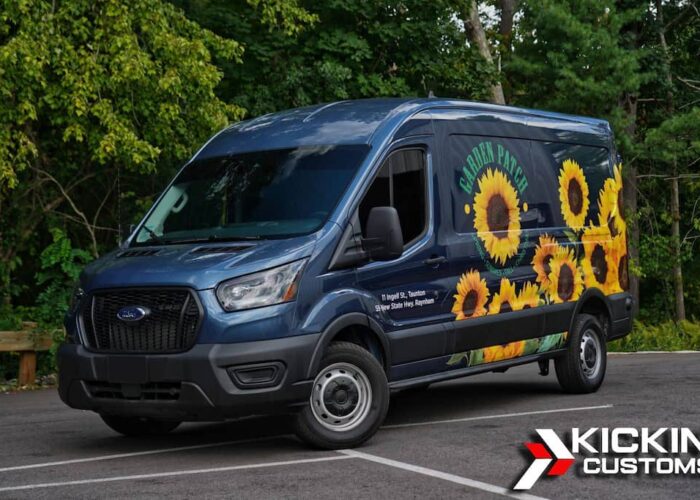
Commercial vehicle wraps and lettering turn cars, trucks, vans, trailers, box trucks, and work vehicles into rolling advertisements. Whether the vehicle is parked at a job site, driving through town, sitting in traffic, or parked in front of a customer’s home, the right graphics can make your business more visible.
That does not mean every business needs a full wrap.
Some companies only need clean lettering. Others need partial graphics. Some need a full commercial wrap. Some need a simple logo, phone number, and website. Others need a full branded design that covers the whole vehicle.
The right package depends on your business, vehicle, budget, branding, and how the vehicle is used.
At Kickin’ Customs in Raynham, MA, we design and install commercial vehicle wraps, lettering, partial graphics, full wraps, vinyl accents, paint protection film, window tint, and ceramic coatings for vehicles across Massachusetts and Rhode Island. For local businesses, commercial graphics are one of the most practical ways to turn daily driving into brand exposure.
Choose your coverage
What Are Commercial Vehicle Wraps?
Commercial vehicle wraps are vinyl graphics installed on a business vehicle to promote the company.
They can include logos, phone numbers, websites, service lists, taglines, colors, photos, patterns, brand elements, social media handles, QR codes, and other business information.
A commercial wrap can be simple or complex.
A plumber may need clean lettering on a white van.
A landscaper may want a partial wrap with bold green graphics.
A contractor may want a truck and trailer branded together.
A detailing company may want a full wrap with photos and service highlights.
A delivery vehicle may need large lettering that can be read from a distance.
The goal is not just to decorate the vehicle.
The goal is to make the business easier to recognize and remember.
Vehicle Lettering
Vehicle lettering is the simplest commercial graphics option.
It usually includes the business name, logo, phone number, website, services, and sometimes licensing or DOT information when needed.
Lettering is popular because it is clean, affordable, and professional.
It works well on trucks, vans, trailers, doors, rear windows, tailgates, box trucks, and service vehicles.
Lettering is also a good choice when the business already has a clean vehicle color and does not need a full visual transformation.
For many companies, simple lettering is enough.
A clean logo, readable phone number, website, and short service list can make the vehicle look professional without overwhelming it.
Partial Commercial Wraps
A partial commercial wrap uses vinyl graphics on selected areas of the vehicle instead of covering every panel.
This might include doors, rear quarters, lower panels, tailgate, hood, rear hatch, rear doors, or a large side graphic.
Partial wraps are a strong middle ground.
They create more visual impact than basic lettering but cost less than a full wrap.
This is a great option for local businesses that want the vehicle to stand out but do not need every panel covered.
A partial wrap can use the original vehicle color as part of the design. For example, a white van can have bold side graphics without needing to wrap the entire van.
When designed properly, a partial wrap can look intentional and professional.
Full Commercial Wraps
A full commercial wrap covers most or all of the vehicle’s painted exterior surfaces with branded graphics.
This is the highest-impact commercial wrap option.
A full wrap can completely change the look of the vehicle and turn it into a strong brand piece.
Full wraps are useful for businesses that want maximum visibility, fleet consistency, bold branding, or a vehicle that stands out heavily in traffic.
They are common for larger companies, service businesses, delivery vehicles, food-related businesses, event vehicles, and brands that want a bigger presence.
Full wraps take more design time, more material, more installation time, and more planning than lettering or partial graphics.
The result can be powerful, but it needs to be designed well.
A full wrap with poor design can still be hard to read.

Design for recognition
Commercial Wraps Are Local Advertising
Commercial wraps are especially valuable for local businesses.
Most service businesses work in a defined area. Contractors, landscapers, electricians, plumbers, HVAC companies, cleaning companies, mobile detailers, restaurants, real estate agents, delivery services, and home service companies are constantly moving through the same towns they want to serve.
A wrapped vehicle puts the business name in front of people in those areas.
The vehicle may be seen in driveways, parking lots, town centers, neighborhoods, job sites, school pickup lines, gas stations, and traffic.
That visibility builds familiarity over time.
A commercial wrap does not guarantee leads by itself, but it helps your business look more established and easier to remember.
For many local businesses, that matters.
Professional Appearance Matters
A business vehicle says something before anyone speaks to you.
A clean, branded vehicle makes a company look more organized and professional.
A plain, unmarked vehicle may be fine for some businesses, but it does not help customers remember who was there.
A poorly designed vehicle can be even worse. If the graphics are cluttered, hard to read, low quality, faded, or mismatched, it can hurt the impression.
Professional commercial graphics should look intentional.
The logo should be clear.
The phone number should be easy to read.
The design should match the business.
The vehicle should look like it belongs to a serious company.
For service businesses, first impressions matter before the customer even opens the door.
Design Is More Important Than Filling Space
A common mistake with commercial wraps is trying to put too much information on the vehicle.
More text does not always create better advertising.
A vehicle is moving. People often have only a few seconds to read it.
That means the most important information needs to be clear and simple.
Business name.
Logo.
Main service.
Phone number.
Website.
Maybe a short service list.
Maybe a tagline.
Maybe a QR code if it is placed where people can actually use it when the vehicle is parked.
The design should guide the viewer’s eye.
A cluttered wrap can be ignored because it is too much work to read.
A clean wrap is usually more effective.
Readability Comes First
Commercial vehicle graphics should be readable from a distance.
This sounds obvious, but it is one of the biggest issues with bad wrap design.
Small text, thin fonts, low contrast colors, busy backgrounds, and too many services can make the vehicle difficult to read.
If someone cannot quickly understand who you are and what you do, the wrap is not doing its job.
Good commercial design uses contrast, scale, spacing, and hierarchy.
The company name should stand out.
The service category should be obvious.
The phone number and website should be easy to find.
The wrap should work while the vehicle is moving and while parked.
A pretty design that cannot be read is not enough.
Branding Should Match Your Business
A commercial wrap should match the business identity.
A luxury home builder should not look like a discount flyer.
A landscaping company may need bold, natural colors.
A detailing company may want sharp, premium imagery.
A plumbing company may need clean service-based messaging.
A performance shop may want a more aggressive look.
A professional service company may need something simple and refined.
The wrap should feel like the business.
This includes color, font, layout, logo placement, photography, icons, and wording.
If your website, business cards, social media, uniforms, and vehicles all look different, the brand can feel scattered.
Vehicle graphics should support the full brand, not fight it.
Lettering vs Partial Wrap vs Full Wrap
Lettering is best when you want a clean, affordable, professional look.
Partial wraps are best when you want more visual impact without the cost of a full wrap.
Full wraps are best when you want maximum visibility and a full branded transformation.
There is no one right answer for every business.
A new business may start with lettering.
A growing business may move into partial wraps.
A larger company may choose full wraps for fleet consistency.
Some businesses use different levels depending on the vehicle.
A sales vehicle may only need lettering.
A main service van may deserve a full wrap.
A trailer may need large side graphics.
The right strategy depends on how the vehicle is used.
Vehicles and fleet branding
Vehicle Type Matters
The vehicle itself affects the design.
A pickup truck has doors, bed sides, tailgate, and smaller graphic areas.
A van has large sides and rear doors, which gives more design space.
A box truck has huge flat panels, which can act like a billboard.
A trailer has long sides that are great for visibility.
An SUV may need a more refined layout.
A small car may need simple, readable graphics because there is less space.
The design should be built around the vehicle’s shape.
Door handles, body lines, windows, fuel doors, sensors, trim, curves, and panel gaps all affect how the graphics are installed and read.
A good commercial wrap is designed for the specific vehicle, not just stretched from a template.
Trucks for Local Businesses
Pickup trucks are common for contractors, landscapers, electricians, plumbers, real estate professionals, mobile services, and small business owners.
Truck graphics can be simple or bold.
Door lettering is the most common starting point.
Bed side graphics can add more visibility.
Tailgate lettering is useful because people see it in traffic.
Hood or rear window graphics may also work depending on the design.
A truck does not always need a full wrap to look professional.
A clean logo, phone number, website, and service category can make a major difference.
For trucks with chrome delete, tint, wheels, or accent wraps, the commercial graphics can be designed to match the overall style.
Vans and Service Vehicles
Vans are some of the best commercial wrap candidates.
They have large sides, rear doors, and high visibility on the road.
Plumbers, electricians, HVAC companies, cleaners, delivery companies, mobile detailers, caterers, installers, and service businesses can all benefit from van graphics.
A van can carry a lot of information, but the design still needs restraint.
The business name should be clear.
The main service should be obvious.
The phone number and website should be easy to read.
The rear doors should be used well because people often sit behind vans in traffic.
Vans give a business a large advertising surface.
The design should make that space work.
Trailers
Trailers are often overlooked, but they can be great advertising surfaces.
Landscape trailers, enclosed trailers, construction trailers, detailing trailers, event trailers, and equipment trailers can all carry branding.
A trailer may sit at job sites for hours, which makes it useful for local visibility.
Large side panels can show the business name, service list, phone number, website, and logo clearly.
Trailers are also useful for businesses that do not want to wrap every truck but still want strong branding when working.
The design should be durable and readable.
Trailers see road grime, weather, job site dust, and equipment contact, so placement and maintenance matter.
Box Trucks
Box trucks offer some of the biggest advertising space.
The large flat sides are ideal for bold branding.
Moving companies, delivery companies, restoration companies, contractors, furniture companies, event businesses, and food-related businesses can all benefit from box truck wraps.
Because the panels are large, the design can be very visible from far away.
But bigger space does not mean more clutter.
The message should still be clear.
Large logo.
Clear service.
Strong phone number.
Readable website.
A box truck wrap can be one of the most visible forms of local vehicle advertising when designed properly.
Fleet Wraps
Fleet wraps help multiple vehicles look consistent.
This is important for growing businesses.
When every vehicle has a different look, the company can feel less organized. A consistent fleet makes the business look more established.
Fleet graphics can range from simple lettering to full wraps.
The key is consistency.
Logo placement, colors, fonts, phone numbers, website, service list, and design style should match across the vehicles.
Different vehicle types may need adjusted layouts, but the brand should still feel the same.
A consistent fleet can improve recognition in the towns you serve.
It also helps employees, customers, and the public identify your vehicles quickly.
Commercial Wraps for Contractors
Contractors can benefit heavily from vehicle graphics.
General contractors, builders, remodelers, roofers, electricians, plumbers, HVAC companies, painters, flooring installers, masons, and landscapers are constantly working in neighborhoods where future customers may live.
A branded vehicle parked at a job site can help neighbors connect the work being done with the company name.
For contractors, the graphics should be clean, readable, and professional.
The service category should be obvious.
The phone number and website should be easy to find.
A contractor wrap does not need to be overly flashy.
It needs to build trust and visibility.
Commercial Wraps for Service Businesses
Service businesses rely on local recognition.
Cleaning companies, mobile detailers, pet services, pest control, pressure washing, pool companies, snow removal, appliance repair, security installers, and other local services can all benefit from branded vehicles.
These vehicles are often parked at homes, businesses, job sites, and public areas.
A clean wrap or lettering package helps people understand who is working nearby.
It can also make the customer feel more comfortable when a clearly branded vehicle arrives.
For service businesses, simple and professional is often best.
People should know who you are, what you do, and how to contact you.
Commercial Wraps for Restaurants and Food Businesses
Restaurants, catering companies, food trucks, bakeries, coffee companies, meal prep businesses, and delivery services can use vehicle graphics to build brand awareness.
Food-related graphics should be clean, appetizing, and easy to understand.
Photos can work, but they need to be high quality.
Poor food photos can hurt the design.
Colors should match the brand and the type of food or service.
The vehicle should make people curious and comfortable.
For food businesses, the design needs to look professional because the vehicle becomes part of the brand experience.
A clean delivery vehicle or branded catering van can make the business feel more established.
Commercial Wraps for Real Estate and Professional Services
Real estate agents, insurance agents, mortgage professionals, home inspectors, consultants, and other professional services can use vehicle graphics too, but the design should be handled differently.
These businesses usually need a cleaner, more refined look.
A full loud wrap may not fit the brand.
Subtle lettering, partial graphics, tasteful branding, or a clean logo package may be better.
For professional services, trust and clarity matter more than visual noise.
The vehicle should look polished and credible.
A clean design can make the business visible without feeling too aggressive.
Commercial Wraps for Trades and Installers
Trades and installers can use vehicle graphics to make the company easier to recognize on job sites.
This includes window tint companies, PPF shops, electricians, remote start installers, security companies, sign companies, flooring installers, tile installers, glass companies, and similar businesses.
The vehicle should explain the service quickly.
The design should also match the quality level of the company.
If the business does premium work, the vehicle should not look cheap.
A well-branded vehicle can show customers that the company cares about details.
For trades, the vehicle is often the first impression at the job site.
Keep the message readable
What Information Should Be on a Commercial Vehicle?
The most important information is the business name, service category, phone number, and website.
A logo is also important if the business has one.
A short service list can help, but it should not be too long.
A tagline can work if it is simple and meaningful.
Social media handles can be useful if they are part of the company’s marketing.
QR codes can be useful on parked vehicles, but they should not replace the main contact information.
The design should answer three questions quickly:
Who are you?
What do you do?
How do people contact you?
Everything else is secondary.
What Should Be Avoided?
Avoid clutter.
Avoid tiny text.
Avoid too many fonts.
Avoid low contrast.
Avoid weak logos.
Avoid blurry images.
Avoid listing every possible service.
Avoid placing important text over door gaps, handles, fuel doors, or deep body lines.
Avoid designs that look good on a screen but cannot be read on the road.
Avoid making the phone number too small.
Avoid designs that do not match the business.
A commercial wrap needs to work in real life.
People are seeing it from distance, in traffic, while walking by, or while it is parked.
Simple usually wins.
Logo Quality Matters
A commercial wrap is only as good as the artwork.
A low-resolution logo can look blurry, jagged, or unprofessional when enlarged.
Vector artwork is usually best because it can be scaled cleanly.
If a business only has a small screenshot of its logo, the design may need to be rebuilt before the vehicle graphics are produced.
This is not a waste of time.
It is part of making the finished vehicle look professional.
A vehicle is a large advertising surface.
Bad artwork becomes very obvious at that size.
Before wrapping a business vehicle, make sure the logo files are usable.
Color Choice Matters
Color affects readability and brand recognition.
A wrap should use colors that match the business but also work on the vehicle.
A dark logo on dark paint may disappear.
White text on a busy photo may be hard to read.
Low contrast colors may look nice up close but fail from a distance.
The vehicle color can be used as part of the design, especially for lettering and partial wraps.
For example, white vans work well with bold colors.
Black trucks may need lighter lettering.
Gray vehicles may need strong contrast.
The best commercial graphics are designed around both the brand and the vehicle.
Font Choice Matters
Fonts should be easy to read.
Fancy, thin, overly decorative, or compressed fonts can be difficult to read on a moving vehicle.
The business name can have more personality if the logo already uses a custom font, but supporting text should stay clean.
Phone numbers, websites, and service lists should be simple.
A vehicle wrap is not a business card.
It needs to work at distance.
A font that looks interesting on a screen may not work on a van driving by.
For commercial graphics, readability is more important than being clever.
Plan the work and approve the design
Approve the Proof Before Production
Once the message is clear, the next step is checking it on the actual vehicle layout. Review both sides and the rear. A strong side design can still lose important information when a sliding door opens, a ladder rack blocks the view, or lettering crosses a panel gap.
Before approving the proof, check the business name, phone number, website, services, colors and exact coverage. Test any QR code and confirm that it opens the right destination. Make sure the proof shows the correct body style, roof height and equipment.
Choose one authorized person to approve the final version in writing. That gives everyone a clear reference for production. Design revisions after approval can change the price and schedule.
Have usable logo files and current vehicle photos ready. Your proposal should explain the design work, included revisions, any artwork cleanup and the files or usage rights included with the project.
What Affects the Price of Commercial Graphics?
Commercial graphics are quoted for the project. Lettering two doors and producing a printed wrap for a large van involve different amounts of design, material, preparation and installation time.
The quote depends on:
- The vehicle size, body style, equipment and condition.
- The panels and surfaces included in the design.
- Lettering, printed graphics, laminate and other selected materials.
- Artwork preparation, layout changes and proofing.
- Removal of existing graphics or adhesive.
- The number of vehicles and the work needed to adapt the branding to each one.
A full color-change wrap price is not a price for a printed commercial wrap. Commercial artwork and production requirements need their own review. We prepare a written quote that identifies the work and coverage before you commit to it.
For a fleet, tell us which vehicles need to stay in service and whether a particular launch date matters. We can review an installation sequence around those needs. Timing is confirmed after artwork, vehicle readiness and material availability have been reviewed.
Check the Surface Before Scheduling
Vehicle graphics need a suitable surface. Healthy factory paint is generally the preferred starting point. Peeling clear coat, corrosion, body damage, recent repairs and existing graphics need inspection before installation.
Vinyl does not repair a weak finish or make dents disappear. If old lettering must come off, its age, adhesive and the paint underneath affect the removal work. Previously covered paint can also look different from exposed paint.
Tell us about repainting, body repairs, coatings and previous graphics when requesting your quote. If the vehicle is leased or owned by someone else, confirm permission and any return requirements before approving the work.
The right preparation protects the design investment. It also gives you a clearer understanding of the finished appearance, the surfaces we can accept and any removal risks.
Care, repairs and your next step
Caring for Commercial Graphics
Keep the graphics clean enough for people to read them. Road grime, salt, fuel spills, bird droppings and job-site contamination affect both appearance and maintenance.
Follow the written instructions supplied with the installation. Under our current commercial-graphics guidance, do not wash the vehicle for the first seven days. Use extra care around lettering, corners, seams and recessed areas during the first two to three weeks.
After that initial period, hand washing is preferred. Rinse loose grit, use pH-neutral automotive soap and a soft mitt, then dry gently with clean microfiber. Avoid brush washes. If using a pressure washer after the initial waiting period, follow the installed film’s limits and keep the spray away from letters, edges, seams and lifted areas.
Report lifting or damage early. Do not pick at an edge, trim it, glue it down or try to force contamination off with pressure. Let us inspect the concern before a small problem spreads.
Repairs, Removal and Future Branding Changes
A damaged graphic may be repairable by replacing a section. The design, available material, retained artwork and surrounding film determine what is practical. New graphics may not match older material exactly because of fading and production differences.
When your phone number, website, logo or service list changes, review the whole vehicle. Updating one detail should keep the message consistent across both sides, the rear and the rest of the fleet.
Removal also needs planning. Film age, exposure, adhesive, paint condition and prior repairs affect the work. Damage-free removal cannot be guaranteed on every surface.
Qualifying commercial-graphics installations include one year of Kickin’ Customs workmanship coverage under the written terms. Manufacturer coverage is separate and depends on the installed material and application. Keep the invoice and care guidance, and contact us promptly if you have an installation concern.
Build a Vehicle People Can Recognize
The best commercial graphics make it easy to understand your business. They show who you are, what you do and how to reach you, using a layout that works on the vehicle and in the places you operate.
That might mean focused door lettering, a partial wrap that uses the original paint color, or a coordinated full-wrap design. More coverage is useful when it supports the message. Clear information and thoughtful placement should guide the decision.
Tell Kickin’ Customs about your business, vehicles, existing artwork, preferred coverage and timing. We will review the details and put together a written proposal for the graphics that fit the job.
Frequently Asked Questions
How much does a commercial vehicle wrap cost?
Commercial graphics are quoted individually. The vehicle, coverage, design work, materials, surface condition, existing graphics and installation requirements affect the price. We provide a written proposal rather than applying a color-change wrap price to a commercial project.
Do I need a full wrap for my business vehicle?
No. Lettering can identify your business clearly, and a partial wrap can add visual impact while using the existing paint color. Choose the coverage around the message, vehicle and budget. A full wrap is one option, not a requirement.
Can you use my existing logo?
Usually. We first review the file quality, fonts, colors and permission to use the artwork. Vector artwork is generally best for scaling. A small screenshot may need cleanup or reconstruction before it is suitable for production.
Do I approve the design before installation?
Yes. An authorized approver must approve the final vehicle-specific proof in writing before production. Check spelling, contact details, QR destinations, placement and coverage carefully. Changes after approval can affect the cost and schedule.
Can different vehicles in a fleet use the same design?
They can share the same branding, but each body style may need its own layout. Roof height, doors, equipment and panel shapes affect placement. The goal is a consistent identity that works on every vehicle.
Can commercial graphics be removed later?
Many graphics can be removed, but the film age, adhesive, exposure, paint condition and prior repairs affect the process and risk. We inspect the vehicle before planning removal. Damage-free removal cannot be guaranteed.
How soon can I wash the vehicle after installation?
Wait seven days under our current commercial-graphics care guidance, then follow the written instructions for the installed film. Hand washing is preferred. Keep pressure away from lettering edges and seams, and contact us if an area starts lifting.
How do I get a commercial-graphics quote?
Use the inquiry form below with your business name, vehicle or fleet details, preferred coverage and timing. Have current photos, logo files and information about existing graphics or body repairs ready. We review the scope before confirming the price and appointment.